
This unit takes you on a journey through the world of myths and legends, where language reveals hidden truths, shapes characters, and brings timeless stories to life.
Mission 1. Share Your Thought
Let’s begin! Think about any myth or story you’ve heard before. Then, answer the questions to share your thoughts and experiences. 1. Have you ever heard about any myths or legends from other countries? What were they about? 2. Can you think of a myth or legend from your culture? Briefly explain it. 3. Why do you think people create myths and legends? What purpose do they serve in society? 4. How do myths and legends help shape culture and traditions? Have you seen any examples of this in your community or family? 5. Have you ever heard a myth or legend that was told differently by different people? Why do you think that happens?
Mission 2. Read and Reflect: A Tale from Japan
Read the following myth from Japan. Afterwards, answer the questions and share your thoughts!
The Tale of the Bamboo Cutter
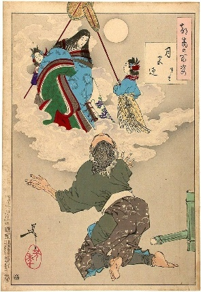
Once upon a time, an old bamboo cutter found a small, glowing bamboo stalk. When he cut it open, he discovered a tiny, radiant girl inside, no bigger than his thumb. The bamboo cutter and his wife raised the girl as their own, naming her Kaguya-hime. As Kaguya grew, she became extraordinarily beautiful, and many suitors came to seek her hand in marriage. However, Kaguya set them impossible tasks, none of which they could complete. Eventually, it was revealed that Kaguya was not human but a princess from the Moon, and she had to return to her celestial home, leaving behind her earthly family. The moon descended, and Kaguya was taken back to the heavens, leaving behind a trail of sadness. This myth is also known as The Tale of Princess Kaguya. It is one of Japan's oldest and most famous folktales. Follow-up questions: 1. Where did the story of Princess Kaguya originate? Can you find any similarities with myths or legends from your own culture? 2. What is the significance of Kaguya’s mysterious origin? Why do you think the myth involves her being from the moon? 3. In the story, Kaguya gives her suitors impossible tasks. Why do you think she does this? What might this tell us about the cultural values of the time? 4. How does the story of Princess Kaguya end? What do you think this ending symbolizes, and how might it reflect the values of Japanese culture? 5. This myth comes from Japan. How does knowing about stories from other cultures help you better understand different perspectives? What did you learn from this myth? 6. Have you ever heard a similar myth in your culture, where a character has to face impossible tasks or goes on a journey? How are these stories similar or different?
Mission 3. Myths and Legends from Different Cultures
Read the two myths: The Legend of Sangkuriang from Indonesia and The Tale of the Phoenix from Greece. As you read, think about what happens in each story, the main message or theme, and the characters and their roles. After reading, answer the questions to compare and understand both myths better.
The Legend of Sangkuriang
This legend comes from West Java and tells the story of Sangkuriang, a young man who fell in love with his mother, Dayang Sumbi, without realizing that she was his mother. Dayang Sumbi, knowing the truth, sets him an impossible task to build a dam and boat in a single night. Sangkuriang almost succeeds but is tricked by Dayang Sumbi, who creates the illusion that the task has failed. In his anger, Sangkuriang kicks the boat, which becomes the large mountain Tangkuban Perahu, and the broken pieces of the boat turn into the surrounding hills.
The Tale of the Phoenix
The Phoenix is a mythical bird known for its ability to regenerate itself. According to Greek mythology, when the Phoenix feels its life nearing its end, it builds a nest of aromatic wood and sets it on fire. The bird then dies in the flames, but from the ashes, a new Phoenix arises. This symbol of rebirth and immortality has been an important part of many cultures, representing the cycle of life, death, and resurrection. Questions: 1. What is the central theme of both stories? How do they reflect the cultures from which they originate? 2. Both myths involve transformations. In The Legend of Sangkuriang, a boat becomes a mountain, while in The Tale of the Phoenix, the bird regenerates from its ashes. What do these transformations symbolize in each culture? 3. Compare the characters in both myths. How does Sangkuriang’s relationship with his mother contrast with the Phoenix’s self-renewal process? What do these characters represent in their respective cultures? 4. What are the endings of both stories? How do the endings in The Legend of Sangkuriang and The Tale of the Phoenix differ in their messages about life and death? 5. How does knowing the origins of each myth (Indonesia vs. Greece) help you understand the cultural values and beliefs represented in the stories? What similarities or differences do you notice in these values?
Mission 4. Sharing Myths and Legends from Around the World
In this activity, you will write or share a myth or legend that you know, either from Indonesia or any other country. This will help you connect with different cultures and understand how stories shape our beliefs and values. Follow this instruction below: 1. Think of a Myth or Legend: Choose a myth or legend that you know. It could be from your own culture, a different culture, or even a fictional one you’ve heard about. It can be a story passed down through generations or one you've read in books, movies, or heard from someone. 2. Complete the Worksheet: Use the table below to write or share key details about the myth/legend you have chosen. If you don’t know all the information, don’t worry! Just do your best.
Myths/Legend Worksheet
| Elements | Details |
|---|---|
Mission 5. Reading Activity
In this activity, you will read two myths/legends from different cultures. These stories contain multiple characters and events, giving you a chance to understand the plot, setting, and cultural context.
The Story of Hercules and the Twelve Labors
Hercules, the son of Zeus and the mortal Alcmene, was destined for greatness, but his life was marred by a terrible tragedy. Driven mad by Hera, the goddess of marriage, Hercules killed his own wife and children. Devastated by his actions, Hercules sought redemption. The Oracle of Delphi told him that in order to atone for his crimes, he must serve King Eurystheus of Tiryns and perform twelve impossible labors. The first of these was to slay the Nemean Lion, a beast so powerful that no weapon could harm it. Hercules, known for his incredible strength, strangled the lion with his bare hands. The second task was to capture the nine-headed Hydra, a creature whose heads would grow back as soon as they were cut off. With the help of his nephew Iolaus, who cauterized the stumps, Hercules managed to defeat the beast. The third task was to capture the Golden Hind of Artemis, a deer sacred to the goddess Artemis. Hercules chased the deer for a year before finally catching it. Over the course of the twelve labors, Hercules faced many other challenges, including cleaning the Augean stables, capturing the Ceryneian Hind, and retrieving the apples of the Hesperides, all of which tested his strength, cunning, and courage. Though Hercules completed all twelve labors, he faced treachery and betrayal from King Eurystheus, who tried to make his tasks even more difficult. Ultimately, after enduring hardships, Hercules was redeemed and became one of the gods on Mount Olympus, immortalized for his strength and heroism.
The Legend of Rama and Sita (Ramayana)
The epic Ramayana tells the story of Rama, the prince of Ayodhya, who was exiled to the forest for fourteen years. His stepmother, Kaikeyi, demanded that her son Bharata be crowned king, and Rama was forced to leave his kingdom. Rama, accompanied by his wife Sita and his loyal brother Lakshmana, went into exile without protest. During their exile, the demon king Ravana, who ruled the island of Lanka, became infatuated with Sita’s beauty. Ravana kidnapped her and took her back to Lanka, hoping to make her his wife. Rama, devastated by the loss of Sita, set out to rescue her with the help of his brother Lakshmana and an army of monkeys led by Hanuman, the monkey god. Rama and his allies built a bridge to cross the ocean to Lanka, where they waged a great battle against Ravana and his demon army. Hanuman played a crucial role, flying across the ocean to deliver Rama’s message to Sita and later setting fire to Ravana’s kingdom. After a fierce battle, Rama defeated Ravana and rescued Sita. However, upon their return to Ayodhya, doubts arose about Sita’s chastity during her captivity. To prove her purity, Sita underwent a trial by fire, emerging unharmed. The epic ends with Rama returning to his kingdom as king, with Sita by his side, but the challenges they faced and the values of honor and devotion are central to the story.
Mission 6. Character Analysis in Myths and Legends
Refer back to the two myths: The Twelve Labors of Hercules and The Ramayana. For each character listed in the table below, provide details or clues from the text that show the character’s personality, actions, or significance. Think about what the character says, does, or how they are described by others. The Twelve Labors of Hercules
| Character’s Name | Character’s Traits | Details from the Text |
|---|---|---|
The Ramayana
| Character’s Name | Character’s Traits | Details from the Text |
|---|---|---|
Mission 7. Through Their Eyes: Understanding Character Motivations
In this mission, you will step into the shoes of a character from the myth you’ve read and rewrite a pivotal scene from their perspective. This will help you understand the character’s inner thoughts, emotions, and motivations. 1. Choose Your Character: Select one character from either of the myths we’ve read: The Twelve Labors of Hercules or The Ramayana. It can be a hero, villain, or any other character who plays a significant role in the story. 2. Pick a Pivotal Moment: Choose an important scene from the myth involving your selected character. For example: • Hercules: The moment when he defeats the Nemean Lion or when he completes the twelve labors. • Rama: The moment when he agrees to go into exile or when he prepares to fight Ravana. 3. Rewrite the Scene from Their Perspective: Imagine that you are this character. Write the scene as if you are experiencing it firsthand. Think about how the character might feel, what they are thinking, and why they are acting the way they are. Focus on the following: • What is motivating the character to take action? • What emotions are they feeling? (e.g., fear, determination, anger) • What internal struggles or doubts are they dealing with? • What are the consequences of their actions? How do they feel about the outcome? 4. Answer These Reflection Questions in Your Writing, after rewriting the scene, reflect on the character’s journey: • What does this scene reveal about the character’s core values and beliefs? • How does the character view the challenges they are facing? Is it about proving strength, fulfilling duty, or something else? • What does this activity tell you about the character’s complexity? How does their internal struggle affect their actions in the larger story? Example: Character: Hercules Scene: Hercules fighting the Nemean Lion Rewrite from Hercules' Perspective: As I approached the Nemean Lion, I could feel the weight of the task ahead. The beast stood before me, its golden fur shimmering, yet I knew it was no match for my strength. But was it just strength that would see me through this? I had to prove to the gods and to myself that I was capable of redemption. My hands tightened around my weapons, but then I thought—no weapon would defeat this creature. It had to be me. I had to rely on my own raw power. Strangling the beast wasn’t easy, but I couldn’t afford failure. For the sins I had committed, this was the only way.
Mission 8. Guess the Characters!
Match each character from The Twelve Labors of Hercules and The Ramayana with the correct description. Each description explains the character’s traits, actions, and role in the story. Write the name of the matching description next to each character.
| Descriptions | Character |
|---|---|
| Descriptions | Character |
|---|---|
Myths and legends are types of narratives, which are stories told to convey cultural values, explain natural phenomena, or entertain. Myths: Myths typically explain natural phenomena, the creation of the world, the origins of gods, and the relationship between humans and the divine. They often involve deities or supernatural beings and aim to answer big existential questions. Examples include the Greek myth of Hercules or the Hindu myth of Rama. Legends: Legends are rooted in historical events, but they are often embellished over time to include supernatural elements. They generally feature human protagonists and focus on heroic deeds, battles, and adventures. While legends may have a historical basis, their details are often exaggerated. Examples include the Legend of Robin Hood or the Legend of Sangkuriang. Myths and legends help explain a culture’s worldview, their values, and the lessons they want to impart through storytelling. They are part of the larger tradition of oral literature that has been passed down through generations. Both myths and legends have been passed down through generations and often serve to shape and reinforce the beliefs and traditions of a particular culture. The structure of myths and legends typically follows a basic narrative pattern: Introduction/Exposition: This part of the narrative introduces the main characters (e.g., heroes, gods, or villains), the setting, and the problem or conflict that the story will address. In myths, this might involve the creation of the world, gods descending to earth, or the introduction of a divine challenge. Complication/climax: The climax is the most intense part of the story, where the hero faces the most difficult challenge or conflict. The outcome of this moment will determine whether the hero succeeds or fails. Resolution: The resolution ties up the loose ends of the narrative, showing the hero's return home or final reward. The lessons or moral of the story are often revealed in this section. In myths and legends, idioms often arise to convey deeper meanings or emphasize the gravity of a situation. These idioms are part of the storytelling tradition and often carry lessons or warnings. Example: “A Herculean task": Refers to a task that is incredibly difficult or seemingly impossible, drawing from the myth of Hercules and his twelve labors.
Mission 9. Reading Between the Myths
Read the myth about Batu Menangis. Pay close attention to the characters, the plot, and the meaning behind the story. Then, look at each statement and decide if it is True or False based on what you read.
The Legend of Batu Menangis
Once upon a time in the village of Sumatra, there lived a mother and her young son named Si Unyil. The mother loved her son dearly, and Si Unyil was the apple of her eye. He was a very playful and energetic child who often wandered into the forest near their home. The villagers loved Si Unyil because of his cheerful personality, and his mother always felt that he was her greatest blessing. One day, while Si Unyil was playing by the riverbank, he heard a sound coming from the woods. Curious as ever, Si Unyil ran into the forest, not realizing that a sudden storm was approaching. As the storm grew stronger, Si Unyil tried to return home, but he was swept away by the powerful river currents. The villagers searched for him, but Si Unyil was lost to the raging water. When Si Unyil’s mother heard the tragic news, her heart was broken, and she cried uncontrollably. She wept for days and nights, calling for her son, but he never returned. Her sorrow and grief were so intense that it is said that her cries turned into stone. The stone was later found by the riverbank, and it is said to resemble a mother’s shape, eternally crying for her lost child. The villagers, moved by her grief, named the stone Batu Menangis, meaning "the crying stone." To this day, it is believed that the stone still cries when a child is lost or in danger. The stone serves as a reminder of the deep love a mother has for her child and the pain of loss.
Statement Check
| Statement | True/False |
|---|---|
Many Indonesian myths and legends are deeply connected to the natural environment, often explaining the origins of natural landmarks, geological features, and local customs. For example, the legend of Tangkuban Perahu, which tells the story of Sangkuriang, explains the creation of the Tangkuban Perahu mountain in West Java, believed to be the remains of a boat turned upside down as a result of Sangkuriang’s anger and failed task. These myths not only serve as cultural stories but also as natural explanations, giving a spiritual and historical context to the landscape that shapes the everyday lives of people in Indonesia.
Mission 10. Figurative Tales and Their Truths
In this activity, you will read two different mythological texts and answer comprehension questions. These questions will test your understanding of the story's plot, characters, and themes.
The Myth of Theseus and the Minotaur
Theseus, the son of King Aegeus, was determined to rid Athens of the terror of the Minotaur, a fearsome half-man, half-bull creature living in the labyrinth of Crete. Every year, Athens had to send seven young men and seven young women as a tribute to King Minos of Crete, who would throw them into the labyrinth to be devoured by the Minotaur. Theseus volunteered to go as one of the tributes in order to face the Minotaur and end the cycle of fear and death. Upon arriving in Crete, Theseus met Ariadne, the daughter of King Minos, who gave him a ball of thread to help him navigate the labyrinth. Theseus tied one end of the thread to the entrance and unwound it as he ventured deeper into the maze. After an intense battle, Theseus defeated the Minotaur and found his way back to the entrance using the thread. He had completed his mission, but on his way home, he tragically forgot to change the sails of his ship to white, signaling his victory to his father. King Aegeus, seeing the black sails from afar, assumed his son was dead and threw himself into the sea.
The Legend of the Monkey King
The Monkey King, Sun Wukong, was born from a stone and became the most powerful of all monkeys. He possessed extraordinary strength and magical abilities, including the power to change shape and the ability to travel on a cloud. Sun Wukong’s arrogance led him to challenge the gods themselves. He sought immortality by stealing the peaches of immortality from the Queen Mother of the West, and after eating them, he gained eternal life. The gods, angered by his actions, tried to punish him, but Sun Wukong was too clever and powerful. He trapped the gods in their own palace and declared himself the "Great Sage Equal to Heaven." Eventually, the Buddha intervened and trapped Sun Wukong under a mountain for 500 years, where he remained until the monk Xuanzang (Tripitaka) freed him. Sun Wukong then vowed to protect Xuanzang on his journey to the West to retrieve sacred scriptures. Over time, the Monkey King learned humility and became a loyal servant to his master, helping him overcome many challenges along the way. Questions: 1. What was the purpose of the tributes sent to King Minos each year, and how did Theseus become involved? 2. How did Princess Ariadne help Theseus in his quest to defeat the Minotaur? 3. Describe the role of the ball of thread in Theseus’ journey through the labyrinth. Why was it important? 4. What mistake did Theseus make on his way home, and what were the consequences of that mistake? 5. What does Theseus’ victory over the Minotaur symbolize for Athens and the people of Greece? 6. What powers did Sun Wukong possess, and how did he use them to challenge the gods? 7. Why did Sun Wukong seek immortality, and what were the consequences of his actions? 8. How did Sun Wukong's actions lead to his punishment, and what was the punishment? 9. What role did the Buddha play in Sun Wukong's story? How did this event change Sun Wukong? 10. How did Sun Wukong's relationship with Xuanzang evolve throughout the journey? What lessons did he learn along the way?
Mission 11. Figurative Tales and Their Truths
Read the two texts below, which feature idioms commonly used in myths and legends. Pay close attention to the idiomatic expressions in the story. After reading, match each idiom with its correct meaning from the list, considering both its literal and figurative meanings in the context of the stories.
| Idiom | Meaning |
|---|---|
Mission 12. Describing Characters and Settings in Myths
Read the two mythological stories: The Myth of Theseus and the Minotaur and The Legend of Sun Wukong carefully, paying attention to the adjectives used to describe key characters and important objects. Underline or highlight the adjectives as you read, focusing on characters (e.g., Theseus, Sun Wukong, the Minotaur) and objects (e.g., Peaches of Immortality, Labyrinth). Then, in the table, check the adjectives that describe each character and object. Some adjectives may describe more than one, so feel free to check multiple boxes for each.
| Description | Theseus | Labyrinth | Minotaur | Sun Wukong | Peaches of Immortality |
|---|---|---|---|---|---|
A noun is a word that represents a person, place, thing, or idea. In narrative texts, nouns are essential because they help to establish the who, what, where, and why of the story. They introduce the characters, locations, and objects that drive the plot forward and provide context to the events of the narrative. Character Identification: Nouns help identify and name the characters in a story. For example, in The Myth of Theseus and the Minotaur, "Theseus" and "Minotaur" are nouns that identify the main characters. Setting the Scene: Nouns describe the places or environments where the events unfold. For instance, words like "labyrinth" or "Athens" in the story immediately give the reader a sense of the physical world within the narrative. Object Representation: Nouns are also used to describe objects that have symbolic meaning or are central to the plot. In The Legend of Sun Wukong, "Peaches of Immortality" or "mountain" are important nouns that symbolize Sun Wukong’s quest for power and immortality. An adjective is a word that describes or modifies a noun. It provides more detail about a person, place, thing, or idea. In a narrative, adjectives help to build vivid images, create emotions, and deepen the reader’s understanding of the characters, settings, and themes. Character Development: Adjectives help to give the reader insight into a character’s personality, appearance, and traits. For example, in The Legend of Sun Wukong, adjectives like "arrogant", "mighty", and "grinning" describe Sun Wukong’s attitude, appearance, and demeanor. Setting the Mood and Tone: Adjectives set the mood or tone of the story. In The Myth of Theseus and the Minotaur, adjectives like "terrifying", "monstrous", and "confusing" create a sense of danger and challenge, making the labyrinth and Minotaur seem intimidating. Enhancing Imagery and Symbolism: Adjectives add layers of imagery to a narrative. For instance, describing the "golden" "immortal" "peaches" in Journey to the West emphasizes their importance, symbolism, and divine quality. In narratives, nouns and adjectives often work together to paint a complete picture for the reader. Nouns give the basic information—who or what is being described—while adjectives provide the details that bring the nouns to life.
Mission 13. Jumbled Tales: The Legend of Sangkuriang
Read the jumbled version of The Legend of Malin Kundang, where the sentences are scrambled and out of order. Your task is to rearrange the sentences into the correct chronological order by numbering them from 1 to 10, following the proper sequence of events in the story.
| Jumbled Story | Correct Order |
|---|---|
In narrative texts, such as myths, legends, and stories, certain language features are used to engage the reader and to bring the story to life. These features help create a vivid, immersive experience by conveying not only the events of the story but also the emotions and atmospheres surrounding them. Characters (Nouns): Narrative texts often focus on characters—the people or creatures in the story. These characters are often defined by certain nouns that identify their roles (e.g., hero, villain, sidekick) and their physical features. Example: In The Legend of Malin Kundang, the characters include Malin Kundang (the protagonist), his mother (the victim), and the villagers. Time and Place (Settings): The setting of the story—where and when the events take place—provides context for the narrative. Example: In The Myth of Theseus and the Minotaur, the setting is Crete, where the labyrinth and the Minotaur are located. Action Verbs (Verbs): Action verbs are used to describe the actions or events that occur in the narrative. Example: In The Legend of Sun Wukong, action verbs like "stole", "defied", and "fought" help to show Sun Wukong’s active involvement in the story. Descriptive Language (Adjectives and Adverbs): Adjectives and adverbs are used to describe the characters, settings, and events. Example: In The Myth of Theseus and the Minotaur, adjectives like "brave", "strong", and "terrifying" describe Theseus and the Minotaur, and adverbs like "fearlessly" or "boldly" describe how Theseus performs his actions. Temporal Words (Time Connectors): Temporal words or time connectives help to organize the events of the story in chronological order. Example: In the story of Sangkuriang, words like "Once upon a time", "Then", and "Finally" help show the sequence of events. Moral and Theme: The theme of a narrative is its central idea or lesson. Example: In The Legend of Malin Kundang, the theme is the consequence of disrespecting one's parents.
Mission 14. Create Your Own Myth or Legend
In this activity, you will create and write your own myth or legend inspired by the traditional features of storytelling. Your myth should include a heroic character, a challenge or obstacle, and a moral lesson. You will also use descriptive language features (adjectives, action verbs, etc.) to bring your story to life. 1. Choose Your Theme: Start by choosing the theme of your myth or legend. What message or moral lesson do you want to convey to your readers? Some possible themes might include: • The triumph of good over evil. • The importance of bravery or wisdom. • The consequences of greed or disrespect. • The origin of a natural phenomenon (e.g., how mountains were formed, or why the moon changes shape). 2. Create Your Characters: Develop your main character(s). Who is your hero or heroine? What makes them special? They could be a god, goddess, mythical creature, or even an ordinary person with extraordinary qualities. Use adjectives to describe their appearance, strengths, and weaknesses. • Don't forget to include villains or obstacles. Who or what will challenge the hero? Is there a monster, a treacherous villain, or an impossible task? 3. Build the Setting: Decide where and when your myth or legend takes place. Is it in a magical forest, a mountain kingdom, or in ancient times? Use adjectives to bring the setting to life. • Think about the atmosphere: Is it mysterious? Dangerous? Peaceful? Try to make your setting vivid and engaging for your reader. 4. Plan the Plot: Outline the sequence of events. What happens first, second, and last? What is the problem the hero faces, and how will they overcome it? • Consider including a twist or unexpected ending. Maybe the hero learns an important lesson or makes a difficult sacrifice. 5. Write Your Story: Write your myth or legend! Use descriptive language to make your characters, setting, and actions vivid. Include dialogue to bring the characters to life and build the plot. • Don't forget the moral lesson! Myths and legends often teach important lessons about values, morality, or nature.
Gratis — tolong sebarkan
Materi dan latihan di sini bisa dipakai siapa saja tanpa membayar dan tanpa mendaftar. Aplikasi Fitri Learning membawa semuanya ke HP, lengkap dengan nilai dan pembahasan, dan jalan tanpa internet setelah diunduh sekali.
Gratis, tanpa akunUnduh aplikasinya → Ilmu yang bermanfaatBagikan ke WhatsApp