
In this unit, you will learn how to clearly express your ideas by using examples to support your statements. You will also explore how to craft a strong thesis for argumentative texts and understand the elements that make an argument convincing and well-structured.
Mission 1. The Insights from the Poster
Read the poster "The Importance of Protecting Forest" below carefully. After reading, answer the following questions based on the information presented in the poster.
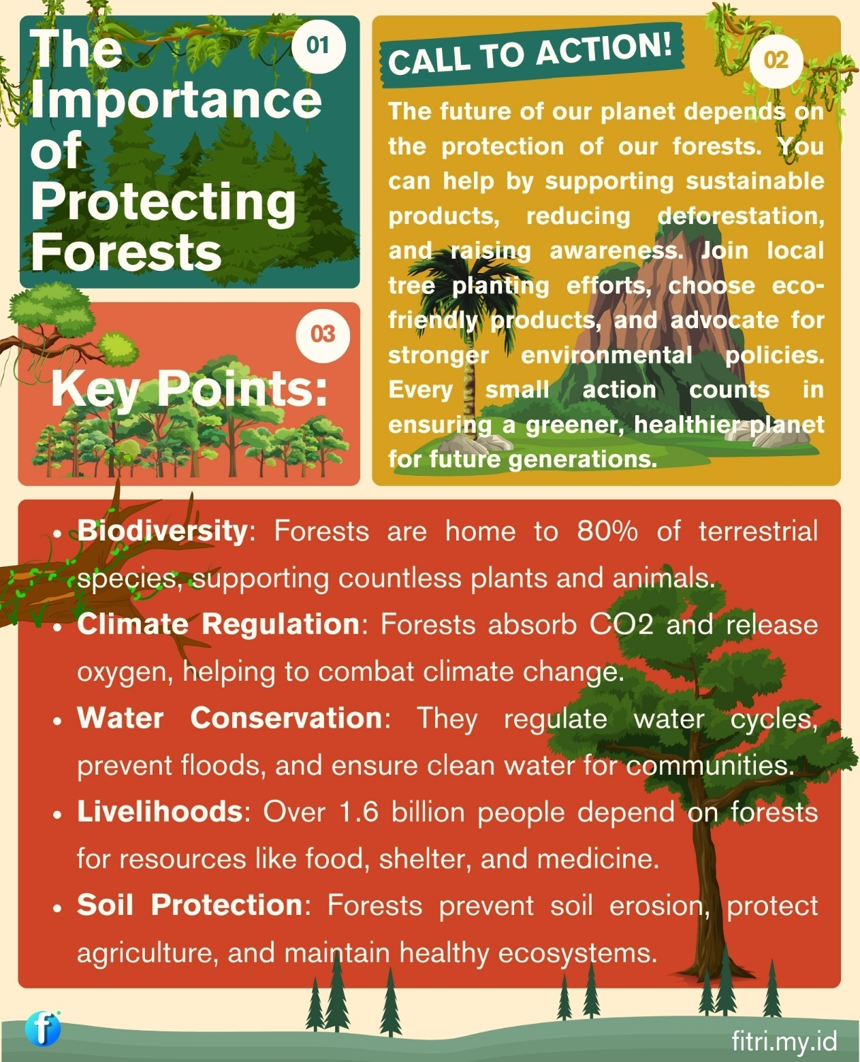
Questions: 1. Considering the connection between forests and biodiversity, what might be the long-term consequences of losing 80% of terrestrial species due to deforestation? 2. Given the role of forests in providing resources for 1.6 billion people, what would be the economic and social consequences of large-scale deforestation for these communities? 3. The poster calls for immediate action in response to forest destruction. What do you think are the most significant barriers to achieving these goals on a global scale, and how can we overcome them? 4. The poster suggests various actions individuals can take to help protect forests. Which action do you think would have the biggest impact? 5. How can we ensure that our support for sustainable products is genuinely contributing to forest protection? 6. In your opinion, what would be the consequence if we didn't take immediate action to protect forests?
Mission 2. A Critical Comparison
Read the three product descriptions below. Each product is related to forest protection and sustainability, but they vary in their environmental impact. After reading the descriptions, answer the following questions critically, thinking about the long-term effects of your choices on the environment, especially forests.
Eco-Friendly Paper Bags
These paper bags are made from 100% recycled paper and are fully biodegradable. They are marketed as a sustainable alternative to plastic bags, helping to reduce plastic waste that harms the environment. However, to make the paper bags, trees need to be cut down, and the process of recycling the paper still requires energy. The company claims that their paper bags are produced sustainably with minimal environmental impact.
Bamboo Toothbrush
This bamboo toothbrush is made with a biodegradable bamboo handle and nylon bristles. Bamboo grows quickly and doesn't require large amounts of water or pesticides, making it an eco-friendly choice for reducing plastic waste. The company promotes it as a plastic-free alternative for personal care products, emphasizing its sustainability and environmental benefits. However, some of the bristles are still made of plastic, and bamboo production requires transportation, which adds to its carbon footprint.
Palm Oil-Free Vegan Soap
This soap is made without palm oil, a commodity that contributes significantly to deforestation in tropical regions. The company claims that by using alternative oils such as coconut and olive oil, they are supporting sustainable farming practices and helping to protect endangered species and ecosystems. However, the production of coconut and olive oil can also lead to land degradation if not done responsibly, and the packaging is made from plastic. Now answer the questions below: 1. Which product do you believe has the least environmental impact, and why? 2. What factors would you prioritize when choosing an environmentally friendly product? 3. In your opinion, is using products like these enough to address environmental issues, or is a larger, systemic change needed? 4. How can you educate others about the environmental impact of everyday products like the ones discussed in this activity? 5. What do you think is the role of businesses and governments in ensuring products are truly sustainable?
Mission 3. Discussing Waste and Forest Protection
Read the conversation below carefully. After reading, answer the following questions based on the content and context of the conversation about the importance of reducing plastic waste and protecting forests. Make sure to support your answers with specific details from the conversation.
Alex: You know, I've been thinking a lot lately about plastic pollution and how it's affecting the environment. We've all heard about how it harms marine life, but what about forests? A lot of plastic waste ends up in forests too, often because people just dump their trash. For instance, I recently saw an image of plastic bags caught in trees, and it really hit me how even our forests are suffering from this issue. Jordan: Yeah, it's shocking how something so small can have such a big impact. I was reading that over 8 million tons of plastic enter the oceans every year. That's just the plastic that's accounted for. But, you're right—it's not just the oceans that are affected. Forests are being impacted in ways we don't always think about. The trees and wildlife suffer, and it also prevents forests from thriving, which disrupts the whole ecosystem. For example, plastic takes hundreds of years to decompose, so it just accumulates, especially in places that aren't being properly managed. Alex: Exactly! And it's not just about plastic bags or bottles—think about all the plastic packaging we use every day. Even when we try to recycle, it doesn't always work because not all plastic is recyclable. I heard that in some countries, people are even burning plastic waste, which releases harmful chemicals into the air and soil. It's a terrible cycle, and it's hard to break unless we really start taking action. Jordan: You're so right. I think one thing that would help is reducing single-use plastics. It's easy to grab a plastic bottle or a plastic bag, but there are alternatives. For instance, reusable bags and water bottles are simple but effective ways to reduce waste. In some countries, they've already banned plastic bags, and it's made a noticeable difference. I think if more people made those small changes, we'd see less plastic waste overall. Alex: I agree with you. The switch to reusable products is such an easy change to make. But I also think that to really tackle this issue, we need stronger policies in place. Governments need to create more sustainable solutions, like better recycling programs or stricter regulations on plastic production. It's not just about what we as individuals can do—it's about having systems that support sustainable choices. Jordan: Right, it needs to be a combined effort. Individual actions can make a big difference, but policy changes and corporate responsibility are just as important. For example, if we encourage more companies to use biodegradable or eco-friendly packaging, it would reduce the amount of plastic that ends up in our forests. And governments could help by providing incentives for businesses to switch to sustainable practices. Alex: That's a good point. And I think public awareness is key too. A lot of people don't even realize how much plastic they use on a daily basis or how damaging it can be. If people started to see the full picture—how plastic affects everything from oceans to forests—maybe they'd be more motivated to make changes. Like, instead of using plastic straws at a restaurant, they could choose a paper or reusable one. Small actions, when done collectively, can have a huge impact. Jordan: Exactly! It's all about shifting our mindset. We need to make these changes not just for ourselves but for the future. It's not going to happen overnight, but with education, awareness, and action, we can make a real difference. After all, protecting our forests is protecting our planet—and that's something we all need to care about. Alex: I couldn't agree more. Every little action counts, and it starts with each of us making more conscious choices. If we all did our part, even in small ways, we could really reduce the amount of plastic that ends up in our forests and oceans. Jordan: It's all connected, right? From the air we breathe to the water we drink—it all comes back to taking care of the earth. So, let's keep talking about it, spreading awareness, and encouraging people to think about their choices. It's time to act before it's too late. Now answer these questions: 1. How does Alex express the idea that plastic waste is harmful to both oceans and forests? 2. How does Jordan explain the importance of small, individual changes like using reusable products? 3. What specific actions do they suggest governments should take to reduce plastic waste? 4. What solutions do they propose for making businesses more responsible for their plastic usage? 5. What personal actions do Alex and Jordan mention as ways to reduce plastic waste? 6. What methods do they think could help educate people about the dangers of plastic pollution?
Mission 4. Expressing Ideas Clearly with Supporting Examples
Choose one of the following topics related to environmental sustainability and conservation. After selecting your topic, write a paragraph and make sure to provide specific examples that illustrate the significance of your chosen topic, and explain how it contributes to a more sustainable and environmentally-friendly future. Topic options: Option 1: The Importance of Reducing Plastic Waste Option 2: The Role of Renewable Energy in Combating Climate Change Option 3: Why Tree Planting is Essential for the Environment Option 4: How Sustainable Agriculture Contributes to a Healthier Planet Option 5: The Benefits of Eco-Friendly Transportation (e.g., electric cars, biking, public transport) Writing guide: Clearly state your main idea or argument (e.g., "Reducing plastic waste is crucial for protecting our environment"). Provide at least two examples that support your argument (e.g., "Plastic waste harms wildlife by choking marine animals, and it takes hundreds of years to decompose"). Use facts or specific examples that help strengthen your statement and provide evidence for your point.
Example: The Importance of Reducing Plastic Waste
Reducing plastic waste is crucial for protecting our environment. Every year, millions of tons of plastic are produced and discarded, much of it ending up in oceans and forests. For example, plastic bags often get stuck in trees, harming not just the trees but also wildlife. A study showed that around 100,000 marine animals die each year from plastic ingestion. Another example is the time it takes for plastic to decompose—some plastics can take up to 1,000 years to break down. This long-lasting impact means that plastic waste continues to harm ecosystems long after it's discarded. By switching to reusable bags and bottles, we can significantly reduce plastic waste and its harmful effects on our planet.
Expressing an idea clearly means conveying your thoughts in a way that is easy to understand. This involves presenting your main idea logically, using simple and direct language, and organizing your points effectively. Giving examples is important because they clarify abstract ideas, making them easier to understand. Examples also strengthen arguments by adding credibility and persuasion, as they support ideas with concrete evidence. Additionally, examples engage the audience, making the content relatable and interesting, and they demonstrate the real-world relevance of concepts, showing how ideas apply in practical situations. How to express ideas clearly by giving examples: Begin by stating your main idea clearly and concisely. This sets the stage for the reader or listener to understand the core message of your argument. After you've stated your main idea, provide specific examples that help illustrate and support your point. These examples should be relevant, clear, and easy to understand. After giving your examples, explain how they reinforce or prove your main point. This helps the audience see the connection between the idea and the example. You don't always have to use the same type of example. You can use statistics, personal experiences, real-world situations, or scientific research to support your ideas. Your examples should be clear and directly related to your main point. Avoid overcomplicating or including irrelevant details that might confuse the audience.
Expressions for Giving Examples
| Expression |
|---|
Mission 5. Argument Mapping
Read the conversation carefully. Answer the following questions and fill in the table with the main argument presented by each character (Anna, David, Eva, and James). Be sure to identify the key points each character makes to support their perspective.
Anna: I firmly believe that banning single-use plastics is crucial for protecting our planet. We have known for decades that plastic waste is a major contributor to pollution, especially in oceans. Plastics don't biodegrade, and they accumulate in ecosystems, causing irreversible damage. Take the Great Pacific Garbage Patch, for example—it's an area in the ocean that is filled with millions of tons of plastic waste. Every year, millions of marine animals die from ingesting plastic or becoming entangled in it. We need to ban single-use plastics, like plastic bags and straws, to reduce this environmental disaster. David: While I agree with the general idea of reducing plastic waste, I don't think a complete ban on single-use plastics is the right solution. I mean, think about the consequences. Banning plastic bags and straws sounds good in theory, but we need to consider the alternatives. For instance, paper bags may seem like a better option, but they require more energy to produce and contribute to deforestation. In fact, the production of paper bags releases more carbon than plastic, so we could be trading one environmental issue for another. Moreover, banning plastic without providing viable alternatives may not solve the problem but simply create new ones. Eva: David, I see where you're coming from, but I think you're missing the bigger picture. Yes, alternatives to plastic have their own environmental costs, but they are still much better than plastic. Paper bags, for example, are biodegradable, and their environmental impact is far less than the hundreds of years it takes for plastic to break down. The key is to shift towards reusable options, not just to swap one disposable item for another. When we ban plastic bags, people will start to use cloth bags or reusable containers, which are a much more sustainable choice in the long run. We need to push for those alternatives and make sure that reusable options are widely available. James: I agree with Eva on the long-term benefits of reusable products. But I also think we need a broader perspective here. The issue with plastic isn't just that it takes years to decompose—it's the fact that we consume so much of it without thinking about the consequences. If we focus solely on banning plastic bags and straws, we're addressing just a small part of a much larger issue. We should look at systemic changes, such as improving recycling programs and encouraging companies to take responsibility for the products they manufacture. Moreover, governments need to incentivize businesses to innovate and find sustainable packaging alternatives. Changing consumer behavior is important, but it also requires a broader shift in policy and industry practices. Anna: That's a valid point, James. And I agree that there should be more focus on corporate responsibility and improving the recycling infrastructure. But we can't wait for everything to fall into place before we act. Every year, tons of plastic waste continue to pollute our ecosystems and harm wildlife. By starting with the ban on single-use plastics, we can create momentum for broader changes, while showing industries and governments that consumers care about sustainability. It's not about waiting for the perfect solution; it's about taking the first step and building from there. David: You both make good points, but I still think we need to tread carefully. While I agree that plastic pollution is a huge problem, I'm concerned that banning one product after another could create unintended consequences. We need to make sure that the solutions we put in place are both effective and sustainable. Otherwise, we could end up with another environmental issue on our hands. That's why I'm advocating for more research and development into biodegradable plastics and more efficient recycling systems—these could be a better middle ground than an outright ban. Eva: David, I understand your concern about unintended consequences, but the urgency of the plastic crisis can't be ignored. We've seen the damage plastic does to our ecosystems for decades, and it's not slowing down. The solutions may not be perfect, but they are a step in the right direction. Once we start with banning single-use plastics and encouraging reusable options, we can keep refining the system. We'll get to the point where we'll have better alternatives in place—biodegradable plastics and efficient recycling—but we need to act now to reduce plastic pollution. Answer the question below! 1. What evidence does Anna provide to support her stance on banning single-use plastics? How does she explain the urgency of the situation? 2. How does David address the potential environmental impact of alternatives like paper bags? 3. What examples or reasoning does Eva use to support her stance on the benefits of banning single-use plastics and shifting to reusable options? 4. What is James' position on the issue? How does he expand the discussion beyond just banning plastic? 5. Identify specific examples or evidence used by Anna, David, Eva, and James. How does each one add weight to their argument?
Identifying Arguments in the Conversation
| Name | Argument |
|---|---|
Mission 6. The Insights from the Poster
Read the thesis statements carefully, then match each piece of evidence to one of the thesis statements above. For each match, provide a short explanation (1-2 sentences) of why the evidence supports the thesis. Make sure to analyze how each piece of evidence directly connects to and strengthens the main argument presented in the thesis.
Thesis Statements
Thesis 1: "Eating a plant-based diet is essential for improving personal health and reducing environmental impact." Thesis 2: "Recycling should be mandatory in all cities to reduce waste and protect the environment." Thesis 3: "Education should focus more on environmental sustainability to prepare future generations for the challenges of climate change." Thesis 4: "Public parks and green spaces are essential for improving mental health and overall well-being." Thesis 5: "The reduction of single-use plastic is crucial for the future of our oceans and marine life."
Example
Statement 1 – Evidence A Evidence A supports Thesis 1 ("Eating a plant-based diet is essential for improving personal health and reducing environmental impact") because it highlights the significant reduction in carbon footprint achieved through a plant-based diet, directly supporting the claim about environmental benefits.
Match the Evidence to Each Thesis
| Evidence | Thesis |
|---|---|
Mission 7. Thesis Development
Choose a topic provided below and create a thesis statement for it. Make sure the thesis statement is a clear and concise sentence that presents the main idea or argument of your essay.
Topic Options
• The Importance of Reducing Plastic Waste • Protecting Forests for a Sustainable Future • The Role of Renewable Energy in Combating Climate Change • The Impact of Overfishing on Marine Life • Sustainable Agriculture: Balancing Food Production and Environmental Protection
After selecting your topic, develop a strong thesis statement. Your thesis should clearly express the main idea or argument you want to make about the topic. Make sure your thesis is specific and debatable, providing a foundation for your essay.
Example
Topic: The Importance of Reducing Plastic Waste Thesis Statement: "Reducing plastic waste is an essential step toward protecting the environment, as it significantly reduces pollution in our oceans and landfills, conserves precious natural resources, and mitigates the harmful effects of plastic on wildlife. By adopting sustainable alternatives, promoting recycling, and raising awareness about the environmental impact of plastic, we can take meaningful action to reduce waste and preserve ecosystems for future generations."
Forests play a crucial role in the global carbon cycle. Through photosynthesis, trees and plants absorb large amounts of CO₂, helping to reduce the impact of greenhouse gases. This makes forest ecosystems essential for regulating Earth's climate.
A thesis is the central claim or main idea of an argumentative text. It states the writer's position on a particular issue and guides the structure of the entire argument. Essentially, the thesis serves as the foundation upon which the entire argument is built. A good argument is persuasive, well-structured, and supported by evidence. It is built on solid reasoning and includes clear, logical connections between ideas. What makes an argument strong: The argument should be clearly expressed, so the reader understands the point being made. There should be no confusion about what the writer is trying to argue. Good arguments are supported by strong evidence such as facts, statistics, research studies, examples, or expert opinions. These support the claims and make the argument more convincing. A good argument follows logical reasoning. Each claim should be backed up with evidence that leads naturally to the conclusion. Logical fallacies, such as jumping to conclusions or making unsupported claims, weaken an argument. A strong argument acknowledges opposing viewpoints (counterarguments) and provides reasons for why those opposing views are less valid or less convincing. A good argument is well-organized, with logical flow from one idea to the next. Each paragraph should focus on a single point, and the ideas should build on one another. A good argument should be convincing and engaging. The writer should be able to persuade the reader to consider or accept their position. Emotional appeals (without being manipulative) can also play a role in persuasion, particularly when discussing issues like environmental protection or social justice.
Gratis — tolong sebarkan
Materi dan latihan di sini bisa dipakai siapa saja tanpa membayar dan tanpa mendaftar. Aplikasi Fitri Learning membawa semuanya ke HP, lengkap dengan nilai dan pembahasan, dan jalan tanpa internet setelah diunduh sekali.
Gratis, tanpa akunUnduh aplikasinya → Ilmu yang bermanfaatBagikan ke WhatsApp