
Learning how to communicate effectively helps us build strong relationships and express ideas clearly. In this chapter, you will develop your ability to construct meaningful conversations, express emotions appropriately, and analyze narrative texts. You will also learn to use prepositional phrases to describe time and place in both spoken and written language. These skills will not only improve your English but also enhance your confidence in everyday interactions and academic contexts.
Happiness isn’t just a feeling—it’s how we connect with others. Whether celebrating success, enjoying time with friends, or appreciating life’s little moments, expressing joy makes conversations more meaningful. In this unit, you’ll learn to ask open-ended questions that spark engaging discussions and naturally express happiness in English.
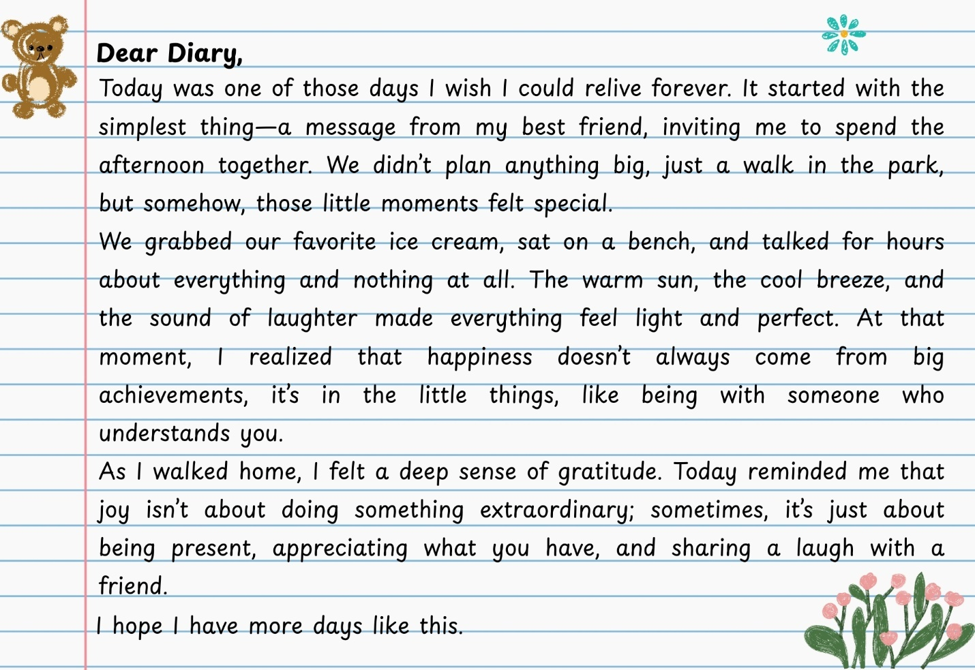
Mission 1. A Diary of Happiness
Read the given diary entry, which describes a personal moment of happiness. Then, answer the reflection questions thoughtfully, making connections between the diary entry and your own experiences with happiness. Questions: 1. Can you relate to the writer’s experience? Have you ever had a simple yet meaningful moment of happiness? 2. Think about a moment when a small, simple event brought you unexpected joy. What happened, and how did it make you feel? 3. The writer found happiness in spending time with a friend. Who is someone in your life that brings you happiness? What do you enjoy doing together? 4. How does the writer use words to make the moment feel special? What words or phrases stood out to you? 5. If you could plan a perfect day filled with happiness, what would you do? Where would you go, and who would you spend it with?
Mission 2. Letters to the Future
Read the dialogue between Nafi, Jaya, and Raya about writing a letter to their future selves. Focus on the expressions they use in the conversation and how they convey their thoughts and emotions.
A Letter for Future Me
Nafi: I just finished writing my letter to my future self, and I have to say, I’m over the moon! It felt amazing to reflect on everything I’ve achieved this year. Jaya: That’s awesome! What did you write about? Nafi: I talked about my biggest moments of joy, like the time I won the school debate competition. I still can’t believe it! I was on cloud nine that day. Raya: That must have been an unforgettable experience! How did you feel when they announced you as the winner? Nafi: Honestly, I was speechless at first, but then I felt like I was walking on sunshine! It was the best feeling ever. Jaya: I love that! It’s so important to hold onto those happy memories. Do you think your future self will be proud when they read your letter? Nafi: I hope so! I reminded myself to keep chasing my dreams no matter what. What about you, Jaya? Have you started your letter? Jaya: Not yet, but now I feel super inspired! I want to write about moments that made me feel on top of the world, like when my artwork was displayed at the school exhibition. Raya: That’s a great idea! What kind of emotions did you feel when you saw your art on display? Jaya: I felt so proud and grateful. It was like a dream come true! Raya: That’s amazing! Writing about those feelings will definitely make your letter more meaningful. I need to start mine too! What advice would you give to your future self to stay happy? Nafi: I told myself to always celebrate small wins and appreciate the people around me. Life’s too short not to enjoy the little things! Jaya: That’s such a great reminder! I think I’ll include that in my letter too. Raya: Me too! This conversation just made me feel so motivated! Analysis of the conversation: After reading the conversation, take a closer look at how each expression is used and how it brings the conversation to life. Fill out the analysis sheet below and answer each question carefully.
| Idioms | Meaning |
|---|---|
| Nafi | Jaya | Raya |
|---|---|---|
Responses in the conversation — write down all the responses you find in the conversation: 1. …………………………………………………………………………………………………… 2. …………………………………………………………………………………………………… 3. ……………………………………………………………………………………………………
Mission 3. The Meaning Hunt
Match each word/idiom with its correct meaning by writing the corresponding letter/number in the matching pair column. Read the words carefully, think about their meanings, and make the best match.
Mission 4. Share a Moment of Joy!
Think of a day that filled your heart with joy. Describe this moment with rich details—what did you see, hear, and feel? Use at least three happiness-related expressions from the previous mission (Mission 3. Meaning hunt) to make your story even more vivid. Make your readers feel the joy just as you did! Example:
The Best Surprise Ever
Last year, on my birthday, I woke up feeling cheerful, but I had no idea the day would turn into one of the happiest moments of my life. My family acted normal, so I thought they had forgotten about my special day. But later that evening, as I walked into the living room, I saw all my friends and family shouting, “Surprise!” I was thrilled! Balloons covered the ceiling, my favorite cake sat on the table, and my best friend handed me a gift I had been dreaming of—a guitar! It was truly music to my ears when everyone started singing “Happy Birthday” together. At that moment, I felt like I was floating on air, completely overwhelmed with joy. I couldn’t stop grinning from ear to ear, knowing how much love and effort went into making that day unforgettable.
Mission 5. Keep the Talk Going
Some parts of the dialogue between you and Reza are missing, and your mission is to complete them using open-ended questions. Think about questions that encourage meaningful discussion, allowing the conversation to flow naturally. Fill in the blanks with suitable open-ended questions that invite deeper responses and engagement. Reza (Student A): "Hey, I just finished writing my letter to my future self!" Me: "That sounds great! ________ (1)?" Reza: "I wrote about my goals and things that make me happy right now, like spending time with my best friends." Me: "________ (2)?" Reza: "One of my best memories was our school trip last year. We had so much fun exploring new places together!" Me: "________ (3)?" Reza: "It was amazing because I got to try new food, take lots of pictures, and bond with my classmates." Me: "________ (4)?" Reza: "I learned that trying new things is important, and friendships grow stronger when you share experiences together." Me: "That’s a great realization! ________ (5)?" Reza: "I hope that in the future, I’ll still have strong friendships and many exciting experiences ahead!"
Mission 6. Ask, Connect, and Engage
Choose one topic that interests you, such as hobbies, school events, travel, favorite foods, or future dreams. Then, write at least three open-ended questions related to your chosen topic. Make sure your questions encourage detailed responses and help keep the conversation going. Example: Topic: travel Open-ended questions: What is the most memorable trip you've ever taken, and why? If you could visit any country in the world, where would you go and what would you do? How do you think traveling helps people learn new things?
Mission 7. Talk and Think
Read the conversation carefully, paying attention to the details, expressions, and context. Then, answer the comprehension questions based on what you have read. Make sure your answers are clear and complete, using information from the conversation to support your responses. Think critically and provide thoughtful answers that reflect your understanding of the dialogue. Alya: "Hey, Jihan. You look a little down. Is everything okay?" Jihan: "Not really… I just found out I didn’t make it to the basketball team. I trained so hard for weeks, and I really thought I had a chance." Alya: "Oh no, I’m so sorry to hear that. I know how much this meant to you." Jihan: "Yeah… I just feel like all my effort was for nothing. Maybe I’m just not good enough." Alya: "Don’t say that! You’re an amazing player, Jihan. Just because you didn’t make it this time doesn’t mean you won’t in the future." Jihan: "I don’t know… It just feels so unfair." Alya: "I can’t imagine how disappointed you must feel. But I really believe in you! Maybe you can talk to the coach and ask for advice on how to improve for next time?" Jihan: "Yeah, maybe… But it still hurts." Alya: "Of course it does, and that’s completely okay. Just know that I’m here for you. If you ever need to talk or even just have some fun to take your mind off things, I’m right here." Jihan: "Thanks, Alya. That really means a lot to me." Alya: "Anytime. And don’t forget—this is just one setback. You’re strong, and I know you’ll bounce back!" Questions: 1. What happened to Jihan that made her feel upset? 2. How does Alya first show concern for Jihan? 3. What are two expressions of sympathy that Alya uses in the conversation? 4. How does Alya encourage Jihan to stay positive? 5. What advice does Alya give to Jihan about dealing with her disappointment?
Mission 8. Speak with Kindness
You will read five short scenarios where someone needs sympathy. For each situation, write a kind and supportive response. Imagine how you would respond in real life.
| Scenario |
|---|
Expressing happiness means communicating positive emotions in response to good news, achievements, exciting experiences, or joyful moments. It helps build stronger relationships and makes conversations more engaging. Common ways to express happiness: Using Direct Expressions: "I’m so happy!" / "That’s amazing!" / "I feel great today!" Using Idioms & Phrases: "I’m on cloud nine!" (Extremely happy) / "I’m over the moon!" (Very excited) / "I’m walking on sunshine!" (Feeling great) / "That made my day!" (Something made you feel good) / "I couldn’t be happier!" (Extremely satisfied) Using Reactions to Someone’s Happiness: "That’s fantastic news!" / "I’m so happy for you!" / "Wow, congratulations!" / "You must be so excited!" Expressing sympathy means showing care and understanding when someone is experiencing a difficult or sad moment. It helps people feel supported and less alone. Common ways to express sympathy: Using Direct Expressions: "I’m so sorry to hear that." / "That must be really hard for you." / "I can’t imagine how you feel." / "That’s really unfortunate." Using Idioms & Phrases: "My heart goes out to you." (Showing deep sympathy) / "Stay strong, things will get better." (Offering encouragement) / "I’m here for you." (Offering support) Offering Comfort & Support: "If you need anything, just let me know." / "You’re not alone, I’m here to help." / "I know it’s difficult, but I believe in you." An open-ended question is a question that requires more than a "yes" or "no" answer. It encourages detailed responses, deeper discussions, and meaningful conversations. Open-ended questions are important because they encourage deeper discussions rather than short responses, keeping conversations engaging and meaningful. They help maintain the flow of dialogue, making interactions more interesting and dynamic. Additionally, open-ended questions improve communication skills by prompting people to think critically and express their ideas more clearly. Example: Alex: "I had a great time at the school festival last weekend!" Tina: "That sounds fun! What was the best part of the festival for you?"
Mission 9. Fill in the Blank!
Read the conversation below and complete the missing parts by filling in the blanks with appropriate expressions of happiness, sympathy, or open-ended questions based on the context. Make sure your responses sound natural and contribute to keeping the conversation flowing smoothly. Rina: "Today started off as one of the best days ever! I got selected to represent the school in the national debate competition!" Toni: "Wow, that’s incredible! ________ (1)?" Rina: "Well, I worked really hard for it, and when they announced my name, I was ________ (2)!" Toni: "That’s amazing! ________ (3)!" Rina: "Yeah, but unfortunately, not everything went well today. I also found out that my best friend, Mira, is moving to another city next month." Toni: "Oh no! ________ (4)." Rina: "Yeah, I don’t know how to feel. I’m happy about the debate, but also really sad that she’s leaving." Toni: "That must be really tough for you. ________ (5)?" Rina: "I guess I’ll just have to make the most of our time together before she moves. Maybe we’ll plan a special day to celebrate our friendship." Toni: "That sounds like a great idea! ________ (6)?" Rina: "I think we’ll go to our favorite café and maybe do something fun, like a movie marathon at my house." Toni: "That sounds like a perfect way to spend time together before she moves. I hope you both have an unforgettable day!"
Strong friendships can significantly enhance your health and longevity? Studies have found that individuals with close social ties experience lower blood pressure, reduced inflammation, and a decreased risk of heart disease. These benefits are attributed to the emotional support friends provide, which helps manage stress and encourages healthier lifestyles.
Gratis — tolong sebarkan
Materi dan latihan di sini bisa dipakai siapa saja tanpa membayar dan tanpa mendaftar. Aplikasi Fitri Learning membawa semuanya ke HP, lengkap dengan nilai dan pembahasan, dan jalan tanpa internet setelah diunduh sekali.
Gratis, tanpa akunUnduh aplikasinya → Ilmu yang bermanfaatBagikan ke WhatsApp