
In this unit, you will explore how to express dreams, desires, and possibilities using hopes, wishes, and the subjunctive mood. From imagining a better future to reflecting on what could have been, you’ll learn how to bring your thoughts to life through powerful and meaningful expressions.
Mission 1. Expression Explorer
Carefully read the dialogue below, focusing on how each character uses expressions to communicate their thoughts, feelings, and ideas. Reflect on the purpose of each expression and how it enhances the overall conversation. Finally, write complete answers to the essay questions provided.
Planning a Dream Camping Trip
The four friends are sitting at a park on a sunny afternoon, brainstorming ideas for their dream camping trip. Lisa: Hey, guys! I’ve been thinking—it’s been way too long since we last went camping. I really hope we can plan something soon. What do you all think? Ethan: Hmm, I like the idea… but I’m not sure where we should go. Let me think about it for a second. What if we go somewhere with both hiking trails and a lake? Lisa: That’s exactly what I was thinking! I wish we could find a spot where we can swim, hike, and maybe even try fishing. How about you, Sophia? Sophia: Give me a moment to think... Okay, what about Pinecrest National Park? It’s supposed to have great trails, a lake, and a stargazing area. Jack: Oh, stargazing? Now that’s something I wish I could do every weekend. If only we had a telescope to make it even better! Ethan: That’s true, but I don’t think we need a telescope to enjoy the stars. Stargazing is still magical without it. Do you think we can camp overnight at Pinecrest? Lisa: Definitely! I hope we can find a weekend when everyone’s free. Oh, that reminds me—we need to figure out what to pack. Jack, what’s your must-have item? Jack: I wish I could say marshmallows and a pillow, but… let me think… We’ll need a tent big enough for all of us, a portable stove, and definitely board games. Sophia: Board games? That’s a great idea. I also hope we can try cooking meals over the campfire. If only I knew how to make a perfect campfire stew! Lisa: I can teach you a little, but give me a moment… We could even look up recipes before we go. I hope we can all take turns cooking—it’ll make it more fun! Ethan: That’s a solid plan. You know, I really hope the weather is perfect that weekend. If only we could guarantee no rain—clear skies would be ideal for stargazing. Jack: True, but even if it rains, I wish we could just laugh it off and enjoy being together. That’s what camping is all about, right? Sophia: Absolutely. It’s about the memories we make. Let’s finalize the dates soon. I’m already imagining how great this trip is going to be! Questions:
• What expressions of hope and wish do you find in the dialogue? Analyze how each character uses these expressions to communicate their thoughts and feelings.
Answer:
• Lisa: “I really hope we can plan something soon.” → Shows her excitement and optimism for starting the trip. • ………………………………………. • ………………………………………. • Why do the characters use pauses or phrases like “give me a moment to think” in their conversation? How does this strategy affect the flow of the dialogue?
Answer: ………………………………………………………………………………….
• Which character’s expressions of hope or wish do you relate to the most? Explain why and give an example of how you might use similar expressions in your life.
Answer: ………………………………………………………………………………….
• How do the characters’ expressions contribute to the theme of planning a camping trip? Which expressions make their conversation more engaging and realistic?
Answer: ………………………………………………………………………………….
Mission 2. Complete the Dialogue
Read the incomplete dialogue below carefully. Use the Expression Bank to fill in the blanks with the most appropriate responses. Write your answers in the spaces provided. Emma and Noah are talking about their weekend camping trip. Emma: Hey, Noah! I’m so excited about our camping trip this weekend. I really hope we’ll have great weather. Noah: Me too! (1) ________________________________________________________. Emma: Thanks! I’m also thinking about what to pack. I wish I had a better backpack—it’s so small. Noah: (2) ________________________________________________________. Maybe I can lend you mine if you need it. Emma: That would be amazing—thanks! Oh, and do you think we’ll be able to build a good campfire? Noah: (3) ________________________________________________________. If only we had some tips from an expert! Emma: I know, right? I also hope we’ll get to see the stars clearly at night. Noah: Definitely! (4) ________________________________________________________. It’ll be so relaxing to stargaze after a long hike. Emma: If only I had a telescope! That would make it even more exciting. Noah: (5) ________________________________________________________. Anyway, let’s finalize our checklist so we don’t forget anything.
• Expressions of hopes and wishes are used to convey desires or aspirations, either for ourselves or others. These expressions often reflect what we want to happen in the future (hopes) or what we wish were true in the present or past (wishes). • Use "hope" followed by the present tense for future events or the past tense for past hopes • Use "wish" with a past tense verb to express a desire for something that is not true or not happening • Example the use of hopes and wishes:
| Hopes and wishes | Responses |
|---|---|
Mission 3. Expressing Hopes and Wishes
Look at the situations provided in the table and write a hope or wish that fits each one, then add a response to match the hope or wish, ensuring you use the correct structure for hopes and wishes.
| Situation | Hope/Wish | Response |
|---|---|---|
Mission 4. Mapping My Dreams: Hopes and Wishes Timeline
Complete the timeline by writing your hopes and wishes for each time period, along with a short explanation or plan to achieve them. Use expressions such as I hope…, I wish…, and if only… to craft your responses clearly and thoughtfully.
My Personal Hopes and Wishes
| Timeline | Hope/Wish |
|---|---|
Mission 5. Letters of Hope and Wishes
Carefully read the letter from Hani to Mika and pay close attention to the expressions of hope and wish used throughout. Then, complete the task by answering the questions that follow.
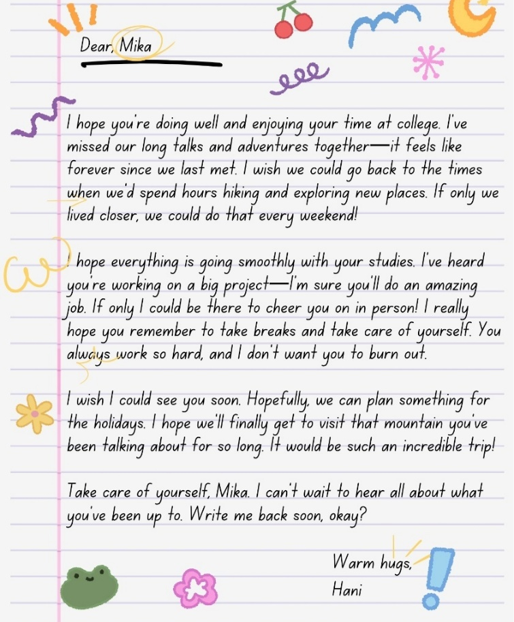
• What does Hani hope for Mika in terms of her studies? • What is one thing Hani wishes they could do together? • Why does Hani say, “If only we lived closer”? • What future plan does Hani hope they can make happen?
Mission 5. Hopes and Wishes Across Time
Complete the chart below by writing two examples of hopes or wishes for each time frame: past and present/future. In the past section, reflect on events that have already happened and express what you wish had been different. In the present/future section, focus on things you want to happen or change moving forward.
| Past | Present/Future |
|---|---|
• The subjunctive mood is a verb form used to express hypothetical situations, wishes, suggestions, demands, or conditions that are contrary to reality. It is often used in formal or polite speech and writing to show something that is not factual or real but imagined, desired, or required. • The subjunctive is more common in formal English. In informal speech, people may substitute it with indicative forms (e.g., was instead of were). • The verb be is unique in that it uses the base form for the present subjunctive (be) and were for the past subjunctive for all subjects. • Key uses of the subjunctive mood • Wishes and desires: The subjunctive is used after verbs like wish to express something that is not true or not happening in the present or past. • Hypothetical Situations: used to describe situations that are contrary to fact or imagined. • Suggestions or Recommendations: The subjunctive follows verbs that make demands, suggestions, or advice (e.g., recommend, suggest, insist, demand). • Formal Expressions: Common expressions like It is important that, It is essential that, or It is necessary that use the subjunctive mood. • The form of Subjunctive Mood • Present subjunctive: Use the base form of the verb (e.g., go, be, write) without -s, even for third-person singular subjects. • Past subjunctive: Use were instead of was for all subjects. • Negative form: Use not before the base form of the verb. • Common expressions: • Wishes: I wish I were, I wish he had… • Hypothetical Conditions: If I were, If she were… • Recommendations: I suggest that, They insist that… • Formal Expressions: It is necessary that, It is important that…
Mission 6. Subjunctive Scenarios
Now that we’ve explored the subjunctive mood, including how to express wishes, discuss hypothetical situations, and make recommendations, it’s time to put your skills into practice! Below are incomplete sentences and prompts—complete each one using the correct subjunctive form to showcase your understanding.
| Complete the sentences to express unreal situations: I wish I ______ more time to prepare for the exam. She wishes it ______ on the weekend. If only I ______ taller, I could join the basketball team. |
|---|
Mission 7. Subjunctive Mood Journal
In this mission, you’ll create your own journal using the subjunctive mood. Follow the instructions below to complete the task and let your creativity shine as you express wishes, hypothetical situations, and recommendations!
• Write a title for your entry, such as “If I Were...,” “Dreaming of the Perfect Day,” or “My Ideal World.” • Write about three things you wish were true in your life. • Describe two "what if" situations and explain how things would change. • Suggest one thing that you believe is important for someone or something to improve. • Make sure to include at least five sentences using the subjunctive mood.
Example:
If I Were a World Traveler
I wish I had the chance to visit every country in the world. If only I had unlimited time and money, I could explore new cultures and try different cuisines. If I were living in Italy right now, I would be eating gelato by the Colosseum. I also dream of traveling to Japan during cherry blossom season. It’s important that I save enough money to make this dream come true someday. I suggest that anyone who loves adventure make traveling a priority.
Mission 8. Matching Game
Below are two columns: contains the first half of sentences, and the second half. Your task is to match the fragments to form grammatically correct sentences using the subjunctive mood.
| First half sentences | Second half |
|---|---|
Full sentences:
• If I were the president, I would implement better education policies. (F) • …………………………. (..) • …………………………. (..) • …………………………. (..) • …………………………. (..) • …………………………. (..)
The idea of wishing upon a star is thought to have originated with the ancient Greeks. The astronomer Ptolemy, in the 2nd century AD, theorized that shooting stars appeared when the gods opened the heavens to gaze upon Earth. During these moments, people believed their wishes had a greater chance of being heard and granted by the gods. Do You Know?The idea of wishing upon a star is thought to have originated with the ancient Greeks. The astronomer Ptolemy, in the 2nd century AD, theorized that shooting stars appeared when the gods opened the heavens to gaze upon Earth. During these moments, people believed their wishes had a greater chance of being heard and granted by the gods. Mission 9. Sentence Transformations
Below are sentences written in the indicative mood (used to state facts). Your challenge is to transform each o ne into the subjunctive mood, turning it into a wish, a hypothetical scenario, or a thoughtful recommendation.
Sentences:
• I don’t have enough time to complete my project.
I wish I had enough time to complete my project.
• She is not here to help us with the preparations.
……………………
• He spends too much time playing video games.
……………………
• The teacher says that everyone should study more carefully.
……………………
• They don’t understand the importance of teamwork.
……………………
• I don’t live in a big city.
……………………
Gratis — tolong sebarkan
Materi dan latihan di sini bisa dipakai siapa saja tanpa membayar dan tanpa mendaftar. Aplikasi Fitri Learning membawa semuanya ke HP, lengkap dengan nilai dan pembahasan, dan jalan tanpa internet setelah diunduh sekali.
Gratis, tanpa akunUnduh aplikasinya → Ilmu yang bermanfaatBagikan ke WhatsApp