
In this unit, you will learn various strategies to maintain a conversation, including using icebreakers, guessing expressions, and telling funny or odd anecdotes. These skills will help you engage your audience, making conversations livelier and more interesting.
Mission 1. Reflecting on Responsible Digital Citizenship
Take a moment to carefully read the "Navigating the Digital World Responsibly" poster. After reading it, reflect on how each point might relate to your own online behavior and experiences. Consider how you use the internet and digital tools in your everyday life. Then, answer the following questions based on your personal reflection.
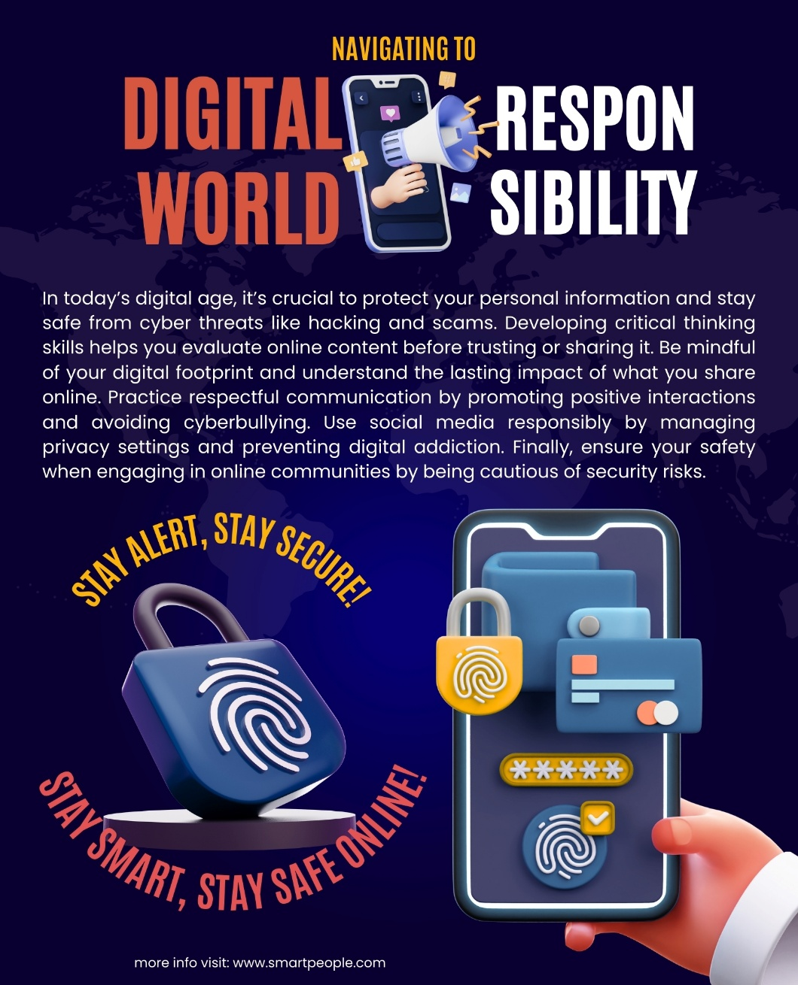
After reading the poster, reflect on your own digital habits and online presence. Consider the following questions:
1. How do you protect your personal information online? 2. Have you ever encountered a situation online where you had to evaluate whether information was trustworthy? How did you handle it? 3. What steps do you take to manage your digital footprint? (e.g., what content you post or share online) 4. How do you communicate online in a respectful manner? Can you recall an experience where you promoted positive interactions? 5. How do you use social media, and what steps do you take to use it responsibly? 6. When participating in online communities, what safety precautions do you take to avoid security risks?
Mission 2. Living in the Digital World
Based on your reflections in previous mission, set goals for improving your digital habits. These goals could be focused on enhancing your online safety, communication, or social media use. Example: "I will update my privacy settings on all social media platforms."
Your digital habits goals: 1. ……………………………………………………………………………………… 2. ……………………………………………………………………………………… 3. ……………………………………………………………………………………… 4. ……………………………………………………………………………………… 5. ………………………………………………………………………………………
Mission 3. Identifying Technology Concepts Through Conversation
Below is a conversation between four people talking about technology. As you read, try to figure out what technology terms or concepts are being discussed, based on the context of the conversation, guess which technology-related term each person is referring to, based on the conversation context.
Adi: "So, I started using this service that allows me to store everything online. It's great because I can access my files from any device, no matter where I am." Nuri: "That's so convenient! I've been using something similar for a while now. It's like a cloud system where all my files are just there, waiting for me whenever I need them." Dimas: "I've heard of those, but I'm always a little skeptical about security. I mean, if everything is out there in the cloud, what if someone hacks into it?" Vita: "I totally get you, Dimas. But most services these days use really strong security measures. They have encryption and even two-factor authentication, so it's pretty safe." Adi: "That's reassuring. I also started paying for a service where I can watch movies and listen to music, and I don't have to store anything on my phone or laptop anymore. It's all streamed directly to me." Nuri: "Oh, I know exactly what you're talking about. I use one of those too. It's awesome because you just pay for a subscription, and you can watch or listen to anything you want, without ever worrying about storage." Dimas: "Sounds great, but I'm still a bit behind on this. I've been sticking to downloading stuff, and I don't know if I can trust paying a monthly fee for just access to content." Vita: "I get where you're coming from, but honestly, it's way more convenient. And it's cheaper than buying everything individually. Plus, you can access it anywhere, so it's pretty flexible." Adi: "Right, I love that I don't have to worry about storage. And speaking of technology, have you ever used those apps that let you view digital objects in the real world through your phone?" Nuri: "Yes! I tried one where I could place virtual furniture in my living room before buying it. It was kind of like a game, but it helped me decide what to buy." Dimas: "That's cool! I've seen a few apps like that. It's like you're interacting with the world around you, but through the lens of your phone. I think they call it augmented something, right?" Vita: "Exactly, it's called augmented reality (AR). It's super fun, especially for games and apps that show you virtual things in the real world." Adi: "That's really cool. I've been wanting to try it. But speaking of immersive experiences, have you tried those VR headsets yet? I heard they're amazing for gaming." Nuri: "Oh, I've used one! It's incredible. When you put the headset on, it feels like you're actually inside the game. The experience is totally different from anything else." Dimas: "I've seen people use VR for exercise too! It's like playing a game while getting a workout. It's kind of mind-blowing how immersive it can be." Vita: "I think VR is the future of gaming, and not just for entertainment. Imagine using it for education or remote work. The possibilities are endless!" After reading the conversation, match each person with the term they are referring to in the conversation, by drawing a line between them.
| Person | Term |
|---|---|
Ice breakers are strategies or activities that are used to help people start a conversation and make the situation more comfortable. Imagine you're at a party, a meeting, or a classroom where you don't know anyone or the atmosphere feels tense. Ice breakers are the tools that help break the "ice" or tension, making it easier for people to talk to each other. In simple terms, ice breakers are questions, comments, or activities that make it easier to start a conversation, especially in situations where people may feel a little awkward or nervous. The function of ice breakers is to initiate conversations and help people feel more comfortable when interacting with others, especially when they are in new social settings. Opening questions: the first questions you ask to begin a conversation. These questions usually focus on something simple and easy for everyone to answer, like hobbies or interests. Examples: "What do you like to do in your free time?" / "Have you traveled anywhere recently?" / "What's your favorite kind of music?"
Responding to Ice Breakers
| Different Ways to Respond | Examples |
|---|---|
Once you've started a conversation, it's important to keep it going and make it interesting. This is where expressions to guess what the other person means or might be interested in come into play. You also need to use certain expressions to help sustain (continue) the conversation. Examples: "Could you be…." / "I'd imagine that…" / "Do you think that…" / "It seems like…" / "What would you say if…" / "Could it be…" / "I wonder if…" / "Is it possible that…" / "I bet that…"
Mission 4. Where Do the Ice Breakers Appear?
Read the conversation below carefully. The conversation is between two people discussing various topics related to the digital world. Pay attention to the questions and responses to identify where ice breakers are used to start and maintain the conversation.
Taylor: "Hey, Sam! Have you checked out the new social media app everyone's talking about?" Sam: "Oh, hey Taylor! No, I haven't. What's it called?" Taylor: "It's called 'Streamly'. It's all about sharing short videos. Have you ever tried posting videos online?" Sam: "I've posted a couple of videos, but I usually just stick to watching others. What about you? Do you make a lot of content?" Taylor: "Yeah, I've started doing some DIY videos. It's so much fun! Do you follow any influencers or creators online?" Sam: "I do! I follow a few gamers. Have you ever watched live streams of people playing video games?" Taylor: "Yes, I've watched some. It's crazy how interactive they can be with their audience. Do you play any games online?" Sam: "I do! I play 'Fortnite' and 'Minecraft'. Do you play any multiplayer games?" Taylor: "I'm more into solo games, but I've played a bit of 'Among Us' with friends. It's pretty fun. What's your favorite part of online gaming?" Sam: "I like the community aspect, especially when I find new people to play with. How do you usually find people to play games with?" Taylor: "I mostly find people through forums and groups on Discord. Speaking of which, have you used Discord for anything other than gaming?" Sam: "Yeah, I'm in a few study groups on Discord. It's a great way to collaborate online. Do you think technology is changing the way we study?" Taylor: "Definitely! I mean, we can access so much information online now, and we can learn in so many different ways. Have you ever taken an online course?" Sam: "Yes, I took an online coding course last summer! It was awesome. Have you thought about learning something new online?" Taylor: "I've been thinking about learning graphic design. I feel like it's a useful skill for creating digital content. Do you have any hobbies that involve technology?" Sam: "I love photography! I've been experimenting with editing photos using different apps. How about you, do you create digital art?" Taylor: "I've started dabbling in it. It's really fun, and there are so many apps for beginners. Maybe we could share some tips! What kind of photography do you focus on?" After reading the conversation, identify the ice breakers used by both Taylor and Sam. Write down the specific questions or comments in the conversation! Ice breakers in conversation: 1. "Have you checked out the new social media app everyone's talking about?" 2. ……………………………………………………………………………………… 3. ……………………………………………………………………………………… 4. ……………………………………………………………………………………… 5. ………………………………………………………………………………………
Mission 5. Fill in the Blank
Read the scenario below carefully. In the conversation, fill in the blanks with the appropriate ice breakers, responses, and expressions to help guess and sustain the conversation. Pay attention to how the conversation flows and use expressions that can keep it going smoothly. Scenario: You meet a traveler who has recently returned from an unknown place. You start the conversation with an ice breaker, then respond to their answers, and finally try to guess the mystery behind their journey.
Tika: "I've just returned from an incredible journey, but it's not a place I can easily describe." Adam: "____________________________________ (Expression to show curiosity and ask for more details about the place) That sounds exciting! Where did you go?" Tika: "I went to a land surrounded by cliffs and mist. It's unlike any place I've seen before." Adam: "____________________________________ (Expression to guess if it's an ancient or hidden place) That's intriguing! Could it be an ancient hidden city or somewhere off the map?" Tika: "It was definitely off the map. No modern technology worked there. I had to rely on old methods of navigation." Adam: "________________________ (Expression to express that you think it was difficult or unsettling) That must have been challenging! Does it ever feel eerie when there's no technology around?" Tika: "Yes, at first it felt strange, but I got used to it. The locals taught me a lot about survival without gadgets." Adam: "_____________________ (Expression to show you think her experience was life-changing) I bet that's a life-changing experience! What did they teach you about survival?" Tika: "They showed me how to find food in the wild. They also taught me to read the stars for direction. It was fascinating." Adam: "____________________________ (Expression to guess if this was a remote tribe) I wonder if this was a remote tribe. How did you communicate with them?" Tika: "We communicated through gestures and symbols. They have their own language, but it's quite simple to understand once you know the basics." Adam: "_______________________ (Expression to comment on their lifestyle and ask if she felt safe) It seems like they live a very different lifestyle from ours. Did you ever feel like you were in danger?" Tika: "There were moments of uncertainty, especially when we ventured into the forest. But the most terrifying thing wasn't what we encountered—it was the unknown." Adam: "_______________________________________ (Expression to ask for more about the danger she faced) What do you mean? Could it be something supernatural that kept you on edge?" Tika: "I'm not sure, but there were sounds at night, strange and unexplainable. I wouldn't want to go back alone." Adam: "_______________________ (Expression to comment that the sounds are a mystery) That sounds like a mystery waiting to be solved. What do you think those sounds were?" Tika: "Maybe you're right. Perhaps I'll return one day and try to uncover the truth."
Mission 6. Tech Terms and Traits Challenge
In this mission, you will first read the provided report texts carefully. Each text will help you understand the key concepts of the terms related to technology and the digital world. After reading the text, you will need to match each term with its corresponding traits.
The Rise of Artificial Intelligence in Everyday Life
Artificial Intelligence (AI) has become a significant part of modern life, influencing industries such as healthcare, finance, and customer service. AI-powered systems can process vast amounts of data, make predictions, and automate tasks, improving efficiency and accuracy. For example, AI is used in virtual assistants, like Siri and Alexa, helping users perform tasks using voice commands. In healthcare, AI assists in diagnosing diseases by analyzing medical images and patient data. As AI continues to evolve, its applications are expected to expand, bringing both opportunities and challenges in terms of ethics, job displacement, and privacy concerns.
The Impact of Social Media on Society
Social media platforms such as Facebook, Instagram, and Twitter have revolutionized communication, enabling people to connect globally in real-time. Social media provides a space for sharing opinions, promoting businesses, and engaging with content. However, it has also sparked debates about its impact on mental health, privacy, and misinformation. While social media can foster community building, it can also contribute to issues like cyberbullying and the spread of fake news. As social media use continues to rise, its effects on individuals and society as a whole remain a critical area of study.
The Evolution of E-Commerce
E-commerce, or online shopping, has transformed the way people buy and sell products. With the rise of platforms like Amazon, eBay, and Alibaba, consumers now have access to a wide variety of goods from around the world. E-commerce offers convenience, allowing customers to shop anytime, anywhere, without the need to visit physical stores. Moreover, businesses benefit from reduced overhead costs and expanded market reach. However, e-commerce also faces challenges, such as cybersecurity threats, customer trust issues, and the environmental impact of shipping. Despite these challenges, e-commerce is expected to continue growing and reshaping global retail.
Cybersecurity in the Digital Age
As more people and businesses engage online, cybersecurity has become a critical concern. Cybersecurity refers to the protection of internet-connected systems from cyberattacks, data breaches, and identity theft. Organizations invest heavily in security measures such as firewalls, encryption, and multi-factor authentication to safeguard their data. With the increasing sophistication of hackers, it is essential for individuals and businesses to remain vigilant. Cybersecurity education, regular software updates, and strong password practices are some of the steps that can be taken to protect against cyber threats. In an increasingly digital world, maintaining robust cybersecurity systems is vital for privacy and data protection.
The Future of 5G Technology
5G technology promises to revolutionize wireless communication, offering faster internet speeds, lower latency, and more reliable connections. This new network generation is expected to support innovations such as autonomous vehicles, smart cities, and the Internet of Things (IoT). With 5G, data transfer speeds could be up to 100 times faster than current 4G networks, enabling real-time communication and the rapid exchange of large files. However, the rollout of 5G faces challenges, including infrastructure costs, regulatory hurdles, and concerns over health impacts. Despite these obstacles, 5G is set to be a game-changer for many industries, enabling new applications and improving existing services.
Each term has 5 traits, and your task is to select the correct traits that best describe each term based on the text. Write the number of the trait next to the correct term.
Traits
Used in virtual assistants, like Siri and Alexa
Requires new infrastructure and regulatory approval
Provides a platform for businesses to market their products
Diagnoses diseases by analyzing medical images
Involves securing online transactions and communications
Allows customers to shop 24/7 from anywhere
Continues to evolve with machine learning
Protects data from cyberattacks and data breaches
Offers faster internet speeds and lower latency
Connects people globally in real-time
Reduces the need for physical stores
Often used for entertainment, education, and socializing
Uses encryption and firewalls for data protection
Is expected to be up to 100 times faster than 4G
Offers businesses a larger market reach
Terms
Artificial Intelligence (AI):
Social Media:
E-Commerce:
Cybersecurity:
5G Technology:
Mission 7. Unveiling the Truth: Digital Literacy Statements
Read the following text about digital literacy carefully. After reading, review the statements provided and determine whether each one is True or False based on the information in the text. Write "True" or "False" next to each statement to mark your answers.
Digital Literacy in the Modern World
Digital literacy refers to the ability to effectively and critically navigate, evaluate, and create information using a range of digital technologies. In today's world, digital literacy is essential for success in personal, educational, and professional life. It involves understanding how to use computers, smartphones, tablets, and other digital devices, as well as being able to search for information online, communicate via email or social media, and protect personal data from security threats. Being digitally literate goes beyond just knowing how to use devices; it also means understanding how to analyze digital information critically. In an age where fake news and misinformation can spread rapidly, digital literacy is crucial for identifying reliable sources of information. In addition to this, digital literacy involves understanding online etiquette and practicing responsible use of social media platforms. It also includes knowing how to ensure online privacy and security by using strong passwords, avoiding suspicious websites, and protecting personal information from cyberattacks. In the professional world, digital literacy is a key skill. Many jobs now require proficiency in software applications such as word processing, spreadsheet management, and even more advanced software for data analysis or design. Digital literacy allows individuals to collaborate efficiently in a globalized work environment and enhances productivity by streamlining communication and task management. As the world becomes more connected through digital platforms, the demand for digital literacy will only continue to grow.
| Statement | True/False |
|---|---|
In conversations, one of the best ways to keep things lively and engaging is by sharing funny or weird experiences. These types of stories can lighten the mood, make people laugh, and make your conversation much more memorable. But knowing how to tell these types of stories in a way that keeps people interested is key. How to tell funny or weird stories: Use an opening sentence that grabs attention, like "You won't believe what happened to me!" or "I've got a funny story for you!" This makes the listener curious and ready to hear more. Describe the situation briefly. Where were you? What were you doing? For example, "I was at a coffee shop when…," or "I was walking down the street when…" Don't just tell the facts. Add funny or quirky details that make the story more entertaining. For example, instead of just saying, "I dropped my ice cream," you could say, "I was holding my ice cream cone like it was the most important thing in the world, and then—boom!—it fell right into the dirt." When telling a funny or weird story, your energy matters. Use exaggeration or dramatic pauses to make the story more engaging. This helps to make your listener react, whether it's laughing, gasping, or asking questions.
Mission 8. Sharing Laughter: Tell Your Funny Story
In this mission, you will read an example of a monologue where one person shares a funny or weird experience. Pay attention to how the story is told and how the listener responds. After studying the example, write your own funny or weird story, using a similar style. Make sure to include engaging details and think about how the listener would react to make the story more interesting and realistic.
You won't believe what happened to me last weekend! I was at this cozy little coffee shop, sitting by the window, just enjoying my coffee and reading a book. Everything was peaceful, until, suddenly, the coffee machine started making these weird noises. I thought it was a malfunction at first, but then—boom! The machine exploded! It was like something straight out of a movie. Coffee shot up into the air, splattering everywhere. I was sitting there, frozen, covered in coffee, and the entire shop looked like it had been hit by a coffee storm. And then, as if nothing strange had just happened, the barista, totally calm, looked at me and said, 'I'm sorry, we ran out of milk.' It was the strangest thing I've ever experienced in a coffee shop. I mean, how do you even react to that? I didn't know whether to laugh or cry. Everyone else in the shop was laughing though, so I joined in. At least, on the bright side, they gave me a free coffee, so that's something, right? I still can't believe it. I mean, who thinks that their coffee experience will turn into an accidental adventure like that? It's one of those moments you never forget. Now it's your turn to share your funny or weird experience. Think of a memorable moment that happened to you and write a short monologue (around 3-5 sentences) describing the event. Focus on making your story engaging and entertaining for the reader.
Mission 9. Term and Definition Match-Up
Read the definitions carefully and make sure you understand what each term represents. Then, match each term with the correct definition from the list. Write the corresponding term next to each definition. Afterward, review your answers to ensure each term is correctly matched with its definition.
| Definition | Term |
|---|---|
Laughter is not only a natural response to humor but also a powerful tool for improving our well-being. It's contagious, as hearing someone laugh can trigger laughter in others, thanks to mirror neurons in the brain. Laughter releases endorphins, the body's natural feel-good chemicals, which promote happiness and can reduce pain. It also helps lower stress by reducing cortisol levels, while boosting immune function by increasing antibodies and activating immune cells. In fact, even simulated laughter, such as in laughter yoga, can provide similar benefits, improving mood and alleviating stress. On average, adults laugh around 15-20 times a day, far less than children, who can laugh up to 300 times a day. Laughter not only improves our physical health but also strengthens social bonds, as shared laughter fosters connection and trust.
Gratis — tolong sebarkan
Materi dan latihan di sini bisa dipakai siapa saja tanpa membayar dan tanpa mendaftar. Aplikasi Fitri Learning membawa semuanya ke HP, lengkap dengan nilai dan pembahasan, dan jalan tanpa internet setelah diunduh sekali.
Gratis, tanpa akunUnduh aplikasinya → Ilmu yang bermanfaatBagikan ke WhatsApp