
Asking meaningful questions and describing things in detail are essential communication skills. They not only help us discover surprising facts but also enable us to present information clearly. In addition, being able to write descriptive texts enhances our ability to share ideas and observations accurately.
Every conversation informs, inspires, and connects. Whether discussing social changes, news, or daily life, expressing surprising facts and sustaining meaningful discussions is essential. In this unit, you’ll learn to ask insightful questions, encourage sharing, and distinguish facts from opinions.
Mission 1. A Bold New Idea
Read the news article "Indonesia Considers Implementing a Four-Day Workweek to Improve Work-Life Balance!" and the conversation between Dimas and Tasya. Then, answer the questions based on both texts, using details to support your responses.
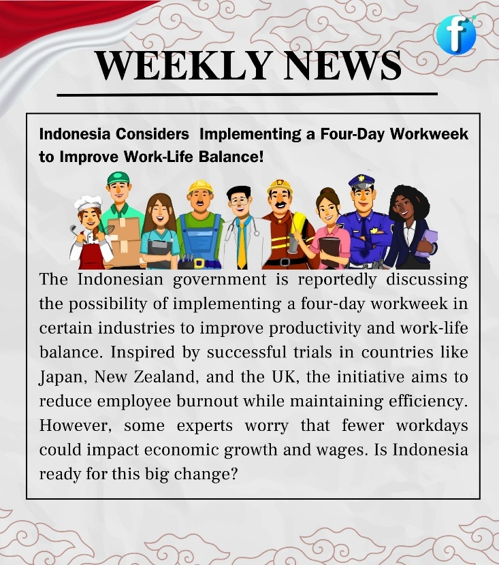
Dimas: "Hey Tasya, did you see the news? The government is considering a four-day workweek!" Tasya: "Really? That sounds amazing! Does that mean people will get three days off every week?" Dimas: "Yeah, in some industries. They say it could make workers happier and more productive." Tasya: "That’s interesting, but what about salaries? Will people still get paid the same?" Dimas: "That’s the big question. Some companies might reduce salaries, but in other countries, they’ve kept the same pay and seen better results." Tasya: "Hmm… I wonder if it would work in Indonesia. What about businesses that need employees every day?" Dimas: "Good point. Maybe only office jobs will have this system, while others still follow a regular schedule." Tasya: "I’d love to have a three-day weekend! But I wonder if it will really happen." Questions: 1. Do you think a four-day workweek would work in Indonesia? Why or why not? 2. What are the advantages and disadvantages of working fewer days? 3. How do you think this change would impact students and schools? 4. How does Dimas support his statement that a four-day workweek could improve productivity? Does he use facts or opinions? 5. If someone disagreed with Dimas’s statement about productivity, how could they use a fact to argue against it?
Mission 2. Today in Indonesia
Read the newspaper about current issues in Indonesia. Then, answer the questions based on the news, using details and examples to support your opinions.
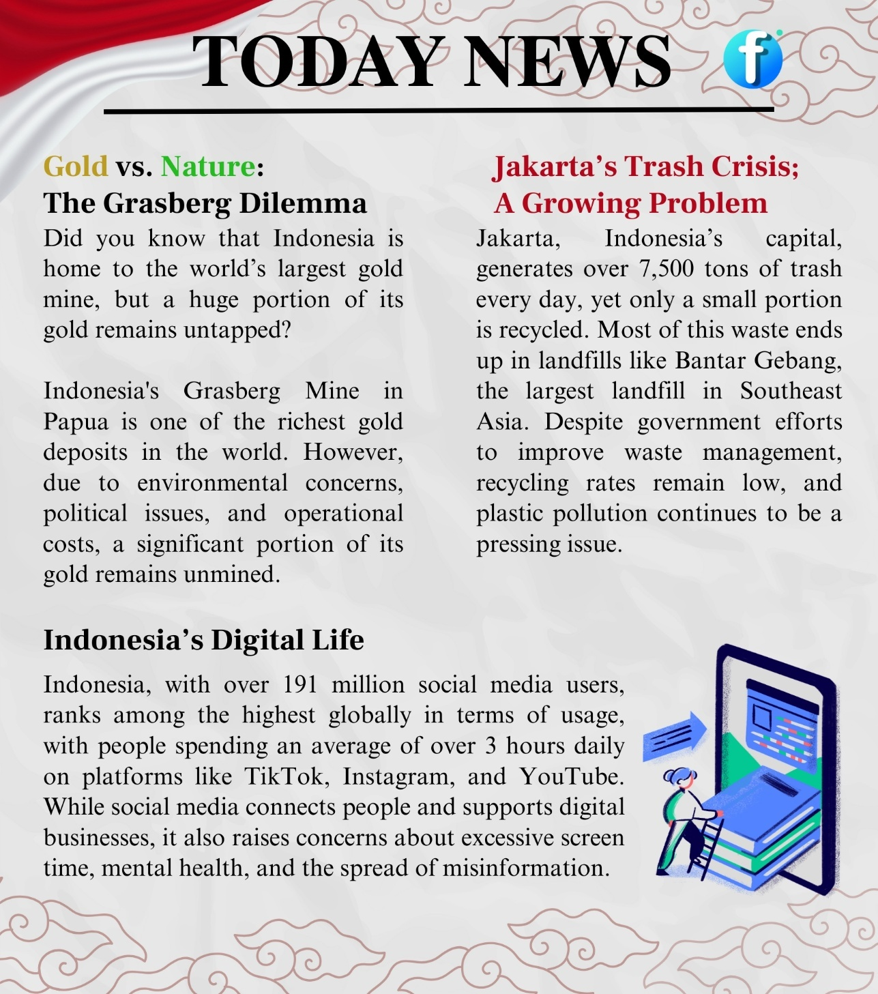
Questions: 1. Which issue surprised you the most? Do you think it has the big impact on Indonesia today? 2. How do these issues affect you personally? Have you ever experienced or noticed any of them in your daily life? 3. Which of these issues do you think more people should be aware of? Why?
Mission 3. Breaking Down the Facts
Read the newspaper in a previous mission (mission 2). Then, review each statement provided and determine whether it is true or false based on the information from the article.
| Statement | True or false |
|---|---|
Mission 4. Fields of Discovery
Read the conversation about surprising facts related to Indonesian agriculture, paying close attention to the key details, facts, and analysis. Think critically about the ideas and opinions presented. Rini: Hey, Adi, I was reading about Indonesian agriculture the other day, and it’s pretty amazing how diverse our farming is. Adi: Yeah, I know we grow a lot of rice, but I’m sure there’s more to it than that. Rini: Exactly! Did you know that Indonesia is actually the largest producer of cloves and nutmeg in the world? Adi: What? I had no idea! I always thought spices like that came mostly from India or somewhere else. Rini: That’s a common misconception. In fact, the Spice Islands, or the Maluku Islands, were the original source of these spices. Adi: That’s really interesting. No wonder the colonial powers were so obsessed with controlling this region back in the day. Rini: Yeah, cloves and nutmeg were so valuable that they were once worth more than their weight in gold. Adi: That’s unbelievable! It’s crazy to think something we take for granted today was once that valuable. Rini: Exactly. I think it’s pretty cool how our country’s history is so connected to spices. Adi: For sure. But do people here still grow cloves and nutmeg like they used to? Rini: Yes, especially in places like North Maluku. But I read that there are challenges now, like fluctuating prices and climate change affecting the crops. Adi: That’s a real shame. I hope we can find ways to support local farmers more. Rini: Actually, some local farmers are turning to organic farming methods to help protect their crops from climate change. Adi: That’s a smart move! I’ve heard organic spices can sell for a higher price too. Rini: Exactly. But it’s still a tough job. Farmers need more support in terms of training, funding, and marketing. Adi: I wonder if the government has programs to help them out. Rini: There are some initiatives, but they’re not always consistent. I think we need more long-term policies to make a real impact. Adi: Do you think promoting Indonesian spices more internationally could help? Rini: Definitely! If we highlight the unique flavor and history of our spices, I think they could become more popular globally. Adi: That’s a great idea! We should share more about the culture and traditions behind these spices too. Rini: Exactly. Imagine a global campaign about "The Spice Journey" – how these spices shaped history and how they’re still part of everyday life in Indonesia. Adi: That would be amazing! People love stories like that, and it would definitely make Indonesian spices stand out. Rini: Maybe we could even start something small ourselves, like creating social media posts or videos about Indonesian spices. Adi: That’s a cool idea! We could show how to cook traditional dishes using nutmeg and cloves. Rini: Yes! And we could talk about where the spices come from and the farmers who grow them. Adi: I love that! It would be a great way to raise awareness and appreciation for Indonesian agriculture. Rini: Totally. It all starts with getting people interested in the story behind what they eat. Adi: Absolutely. You know, this makes me appreciate our local farmers so much more. Rini: Me too. They work so hard, and they’re such an important part of our culture and economy. Adi: Alright, you’ve convinced me. I’m going to make a point to use more local spices in my cooking. Rini: That’s the spirit! Let’s plan a day to cook something together using only Indonesian spices. Adi: Deal! It’ll be a delicious way to celebrate our local agriculture.
Mission 4. Inside the Lines
It’s time to dive deep into the analysis of the conversation about surprising facts in Indonesian agriculture in Mission 3! Break down the key points, explore the opinions shared, and uncover the details.
| Sentence (speech) | Explanation |
|---|---|
In a conversation, expressing surprise and sustaining the dialogue are essential skills for keeping discussions engaging and natural. Here are detailed explanations of various expressions used to describe surprising facts and sustain a conversation: Expressions to describe surprising facts: "Did you know…?" / "Guess what…?" / "It might surprise you to learn that…" / "Here’s something interesting…" / "Believe it or not…" / "You won’t believe this, but…" / "What’s surprising is…" / "It’s hard to believe, but…" / "A lot of people don’t realize that…" / "Would you believe that…?" Expressions to sustain conversation: "That’s really interesting. Tell me more." / "Why do you think that is?" / "What are your thoughts on that?" / "How do you feel about that?" / "I wonder what would happen if…" / "That makes me think about…" / "That’s a good point." Understanding the difference between opinion and fact adjectives is important for clear and accurate communication. Fact Adjectives: These describe facts that can be verified or proven true. Opinion Adjectives: These describe personal feelings, judgments, or viewpoints.
Mission 5. Conversation Builder
Dive into the dialogue below and bring it to life! Use the word bank to fill in the blanks with the most fitting expressions. Choose words that make the conversation flow naturally and add meaning to each exchange.
| Describing surprising facts | Sustaining conversation | Gathering more information |
|---|---|---|
Rizki: Hey, Sarah, I was reading about festivals around the world, and I found out that Indonesia has some pretty unique ones. Sarah: Really? Like what? Rizki: Well, _______(1) there’s a festival called Pasola on the island of Sumba, where people ride horses and throw spears at each other as part of a ritual? Sarah: _______(2)! That sounds intense! Rizki: Yeah, it’s part of a tradition to honor their ancestors and ask for a good harvest. _______(3) what it’s like to see that in person. Sarah: _______(4). It must be an incredible experience, but also a little scary. Rizki: Absolutely. _______(5) that there’s also a festival called "Makepung" in Bali, where people race buffaloes through muddy tracks? Sarah: _______(6)! I’ve never heard of that before. Rizki: I read that it’s a way for local farmers to celebrate their hard work and bond as a community. _______(7) how challenging it must be to control a buffalo in a race. Sarah: _______(8). It must take a lot of skill and strength. Rizki: There’s another festival called the "Bau Nyale" festival in Lombok, where people gather to catch sea worms. _______(9) why it’s such a popular event. Sarah: _______(10). It’s probably connected to their local legends or traditions. Rizki: _______(11) how many other unique festivals are out there across Indonesia that we haven’t heard of. Sarah: _______(12). Maybe we should plan a trip to experience some of these festivals firsthand!
Mission 6. The Comprehension Challenge
Carefully read the text and the conversation provided. Focus on understanding the key details, ideas, and any points of discussion. Afterward, answer the questions based on what you’ve read, using examples from the text and conversation to support your responses.
Indonesia’s Makepung Buffalo Races: A Unique Celebration of Culture
The Makepung Buffalo Races are a traditional festival held in Bali, Indonesia. This unique event takes place in Jembrana Regency and involves local farmers racing water buffaloes through muddy tracks. The buffaloes are decorated with colorful ornaments, and the farmers, called jockeys, stand on small wooden plows behind them. The Makepung races are not only a competition but also a celebration of community and hard work. This tradition began as a friendly rivalry between farmers and has grown into a major cultural event that attracts both locals and tourists. The event symbolizes gratitude for the harvest season and fosters a sense of togetherness among participants. In recent years, there have been efforts to promote Makepung as a tourist attraction, but some worry that the commercialization of the festival might overshadow its cultural significance. Supporters believe that if done carefully, tourism can help preserve this tradition for future generations. Dialogue: Abi: Hey, did you guys read about the Makepung buffalo races in Bali? It sounds pretty intense! Gina: No, I haven't heard about it. Did you know that water buffaloes race in a festival? That's surprising! Vikan: Yeah, I read about it once. What’s surprising is how decorated the buffaloes are for the races. They wear all these colorful ornaments. Abi: That’s true! It makes me wonder how challenging it must be for the jockeys to control them on a muddy track. Gina: That’s a good point. Racing on a muddy track must take a lot of skill and strength. Have you ever seen anything like that before? Vikan: Not really. In my experience, most festivals are more about performances or ceremonies. This one’s like a real competition. Abi: Exactly! Would you believe that this started as a friendly rivalry between farmers? Now it’s a major cultural event. Gina: That’s unbelievable! I didn’t know it had such humble beginnings. Vikan: Yeah, and now they’re even promoting it as a tourist attraction. How do you feel about that? Abi: I think it’s a good idea, as long as they don’t lose the cultural significance of it. It would be sad if it just became a tourist show. Gina: That makes me think about how other traditions have changed over time due to tourism. Vikan: Let’s look at it from another angle. Tourism can help fund the preservation of cultural festivals, right? Abi: That’s a good point. It’s all about finding the right balance. Gina: I completely agree. Maybe we could plan a trip to Bali and check out the Makepung races one day. It would be amazing to see it in person! Vikan: Yeah, tell me more about what else happens at the festival. Is it just racing? Abi: They also have cultural performances and food stalls. It’s a full day of celebration, not just the races. Vikan: That sounds incredible. It must be a great way to experience local culture. Gina: Absolutely! We should definitely experience it firsthand. Questions: 1. What surprising fact did Abi mention about the origin of the Makepung buffalo races? 2. How did Vikan sustain the conversation when talking about the decorated buffaloes? 3. What expression did Gina use to show her surprise about the origins of the festival? 4. What example did Abi give to highlight the cultural significance of Makepung? 5. How did Vikan compare the Makepung festival to other festivals he has experienced? 6. How did Gina use an expression to sustain the conversation about how other traditions have changed over time? 7. What follow-up question did Abi use to encourage further discussion about the festival?
Mission 7. Finding Meaning in Dialogue
Read the dialogue between Abi, Gina, and Vikan, and identify the expressions used. Classify each expression into the appropriate category: Describing Surprising Facts, Sustaining Conversations, or Gathering Information. Then, fill in the table with the identified expressions.
| Describing Surprising Facts | Sustaining Conversations | Gathering Information |
|---|---|---|
Bali is a spiritually significant island with over 20,000 temples, deeply rooted in Hindu culture and home to regular religious ceremonies. One of its famous temples, Tanah Lot, offers stunning views of the Indian Ocean, especially at sunset. Another interesting fact is, Bali's Tegallalang rice terraces are a UNESCO World Heritage site, known for their beauty and traditional subak irrigation system, a cooperative method dating back to the 9th century that keeps the rice paddies fertile.
Mission 8. Fact Detective
Read the provided text carefully and identify key facts mentioned. Then, review the statements given about the text and determine if they are true or false based on the information provided. For each false statement, correct it to make it true.
Borobudur – The Largest Buddhist Temple in the World
Borobudur Temple, located in Central Java, Indonesia, is considered the largest Buddhist temple in the world. This architectural masterpiece was built during the 8th and 9th centuries by the rulers of the Syailendra Dynasty, a powerful kingdom known for its influence in promoting Mahayana Buddhism in the region. The temple is constructed from andesite volcanic stone and features nine stacked platforms: six square platforms and three circular platforms, topped by a large central dome. Borobudur is decorated with over 2,600 intricately carved relief panels that depict scenes from the life of Buddha and stories from ancient texts, such as the Jataka tales. These carvings serve as a guide for pilgrims as they walk clockwise around the temple’s terraces, symbolizing a spiritual journey toward enlightenment. The temple also has 504 Buddha statues, many of which sit inside perforated stupas on the upper terraces. The structure of Borobudur is designed to represent the three realms of Buddhist cosmology: Kamadhatu (the world of desire), Rupadhatu (the world of form), and Arupadhatu (the world of formlessness). Each level represents a different stage on the path to Nirvana, with the central dome symbolizing enlightenment itself. Borobudur was abandoned in the 14th century due to the spread of Islam in Indonesia, which led to a decline in Buddhist practices. It remained hidden for centuries, buried under layers of volcanic ash and jungle growth, until it was rediscovered by Sir Thomas Stamford Raffles in the early 19th century when he served as the British Governor-General of Java. In 1973, a major restoration project led by UNESCO and the Indonesian government began to preserve the temple. The restoration, which lasted nearly a decade, focused on stabilizing the structure, cleaning the reliefs, and preventing water damage caused by the tropical climate. Today, Borobudur is a UNESCO World Heritage Site and remains an important center for Buddhist pilgrimage, especially during Vesak Day celebrations, which honor the birth, enlightenment, and death of Gautama Buddha. Despite its historical and cultural significance, Borobudur faces ongoing challenges related to preservation, including damage caused by weathering, earthquakes, and the impact of tourism. Measures have been introduced to limit visitor access to sensitive areas and promote sustainable tourism practices. The local community also plays a vital role in protecting Borobudur, with initiatives such as educational programs, cultural workshops, and eco-friendly tourism projects. Fact checking Borobudur Temple:
| Statement | True or false |
|---|---|
Mission 9. Uncovering Batik
Imagine you are a journalist interviewing an expert about the tradition of Batik-making. Your task is to gather detailed information by asking open-ended questions that encourage the expert to share insights, stories, and deeper explanations about this cultural tradition. Fill in the blanks in the journalist's speech to make the conversation complete and meaningful.
The Tradition of Batik-making
Journalist (You): Good afternoon! Thank you for taking the time to speak with me today. I’d love to learn more about the tradition of Batik-making in Indonesia. _____________________________________________________________________(1) Expert: Sure! Batik-making is a traditional art form in Indonesia that involves applying wax to fabric and then dyeing it. The parts covered in wax resist the dye, creating intricate patterns. Journalist (You): That’s amazing! __________________________________________________(2) Expert: Yes, it’s a significant recognition for our culture. It helps the world understand how important Batik is to Indonesian heritage. Journalist (You): ______________________________________________(3) How long does it usually take to create one? Expert: It really depends on the complexity of the design. Some Batik, like Batik Tulis (hand-drawn Batik), can take several weeks to finish. Journalist (You): ____________________________________________________________(4) In my experience, I’ve seen Batik with simpler designs that were made more quickly. Expert: Absolutely! There are different types of Batik, such as Batik Cap (stamp Batik), which is faster to make. Journalist (You): __________________________________________________________________(5) Expert: Certainly! Batik Tulis is often worn during special events or ceremonies, while Batik Cap is commonly used for everyday wear because it’s more affordable. Journalist (You): __________________________________________________________________(6)
Gathering information is the process of collecting facts, details, or opinions about a specific topic. It involves actively listening, asking questions, and using different sources to gain a better understanding. Tips to gather information: Be Clear About Your Purpose. Use Multiple Sources. Ask Open-Ended Questions. Listen Actively. Asking for information is an essential skill for effective communication. It involves using different types of questions to gather facts, opinions, or details. Encouraging others to speak helps create a more engaging and inclusive conversation. It allows for the exchange of different perspectives and makes the discussion more interesting. Strategies to encourage others to speak: Invite Opinions. Acknowledge Contributions. Show Interest. Create a Comfortable Environment. Comparing information involves evaluating different pieces of information to highlight similarities, differences, or perspectives. This helps deepen understanding and enriches the conversation. Ways to compare information: Highlight Similarities. Emphasize Differences. Use Personal Experiences. Draw Conclusions.
Gratis — tolong sebarkan
Materi dan latihan di sini bisa dipakai siapa saja tanpa membayar dan tanpa mendaftar. Aplikasi Fitri Learning membawa semuanya ke HP, lengkap dengan nilai dan pembahasan, dan jalan tanpa internet setelah diunduh sekali.
Gratis, tanpa akunUnduh aplikasinya → Ilmu yang bermanfaatBagikan ke WhatsApp