
In this unit, we'll dive into the art of communication and how to express ourselves in a more varied and creative way. Often, we tend to repeat the same phrases when responding, but this unit will guide you through different expressions that can make your responses more dynamic and interesting. Whether in conversations or written form, mastering these expressions will help you sound more fluent and confident.
Mission 1. Sharing Insights
Study the table below, which contains data about various natural disasters. After reviewing the data, answer the following questions by sharing your thoughts and responses based on the information in the table. Make sure to express your ideas clearly and provide varied responses, avoiding repetition.
| Disaster | Location | Date | Affected Areas | Victims |
|---|---|---|---|---|
Answer these questions based on the information in the table. 1. How many victims were affected by the earthquake in Turkey? 2. What areas in Pakistan were most affected by the flood? 3. How would you compare the typhoon in the Philippines to the wildfire in Australia in terms of affected areas? 4. How would you describe the damage to infrastructure in Turkey after the earthquake? 5. In what ways did the wildfire in Australia affect the environment? 6. How many victims were reported in the volcanic eruption in Indonesia? 7. Which disaster do you think affected villages and residential areas more significantly: the earthquake or the flood? 8. What types of areas were most vulnerable during the volcanic eruption in Indonesia? 9. How does the number of victims in the flood in Pakistan compare to the wildfire in Australia? 10. What types of relief efforts would be necessary in the regions affected by the typhoon in the Philippines?
Mission 2. Express Your Ideas!
In this mission, you will practice responding to questions about littering and its impact on the environment, using varied expressions to describe the same idea. This will help you develop the ability to express yourself creatively and avoid repeating the same response.
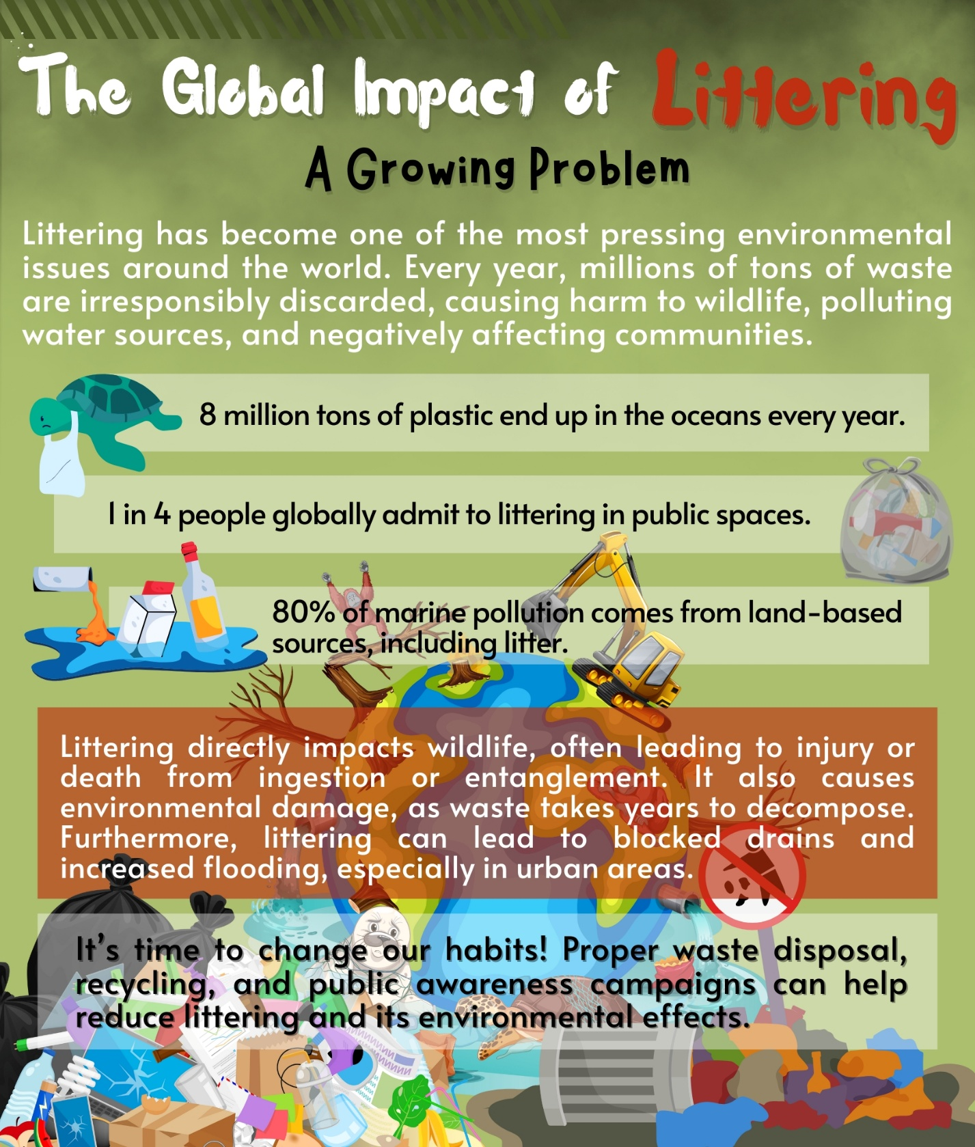
Express your ideas and provide thoughtful answers to the following questions based on the poster.
1. What are some of the areas most impacted by littering in urban environments? 2. How does littering contribute to environmental damage, especially in cities? 3. What measures can be taken to reduce the impact of littering on the environment? 4. How can social media and digital platforms be used to raise awareness about littering? 5. How do you feel when you see littering happening in public spaces? 6. What do you usually do when you see litter in your surroundings? 7. In your opinion, what are the main reasons why people litter?
Mission 3. A Dialogue on Disasters
Read the dialogue below, which discusses the impact of natural disasters. Pay attention to how each character talks about different aspects, such as environmental damage, economic effects, and the importance of preparedness. After reading, answer the questions based on the information shared in the dialogue.
Joe: Hey, Sammy! Have you been following the news about all these natural disasters lately? It seems like they're happening more and more often. Sammy: Yeah, it's really concerning. Just last month, there was a massive earthquake in Turkey. Thousands of people lost their homes. Andra: I've been hearing a lot about hurricanes too. Hurricane Maria was one of the most devastating ones. I think it caused over 3,000 deaths, and a lot of people were left homeless in Puerto Rico. Dani: That's terrible. Hurricanes cause such severe flooding and can wipe out entire cities. I remember when Hurricane Katrina hit New Orleans in 2005. It was one of the worst natural disasters in the U.S. Joe: Exactly. Hurricanes flood entire communities, leaving them without electricity, clean water, and sometimes even food. And then there's the destruction of infrastructure, like roads and buildings. Sammy: Yeah, it's not just about the immediate effects either. The long-term damage is huge. After a hurricane or earthquake, it takes years for the affected regions to recover, both economically and socially. Andra: The same goes for wildfires. Look at the 2020 wildfires in California. Over 10,000 square kilometers of land were affected, and it caused at least 30 deaths. The damage to forests and wildlife was severe. Dani: Wildfires are terrifying because they can spread so quickly. They can destroy entire communities in hours. And the smoke can travel for miles, affecting people far from the fire itself. I remember in Australia, the 2019–2020 bushfires were devastating, especially for wildlife. Joe: Right. And after wildfires, the risk of mudslides increases. The land becomes unstable without the vegetation holding it together. That just adds more danger to an already dangerous situation. Sammy: That's why the aftermath of natural disasters is so complicated. It's not just the immediate danger – it's the ongoing impact on the environment and people's lives. In places hit by earthquakes, the infrastructure is often destroyed, and people are left stranded. Andra: The same thing happens with wildfires and floods. Communities have to rebuild from scratch, and that takes so much time and resources. The people affected also face long-term health issues from smoke inhalation or contaminated water. Dani: And then, the economy takes a hit too. When businesses are destroyed, jobs are lost, and tourism, which is often the main source of income in disaster-prone areas, can drop dramatically. Just look at Puerto Rico after Hurricane Maria. Joe: Absolutely. That's why preparedness is so important. Governments should invest in infrastructure that can withstand these disasters. And communities need to have disaster response plans in place. Sammy: I completely agree. It's also essential that we address the role of climate change. We know that climate change is making natural disasters worse – more frequent, stronger hurricanes, hotter temperatures leading to wildfires. Andra: That's true. We need to do everything we can to mitigate climate change. At the same time, we need to educate people about disaster preparedness and make sure everyone knows how to stay safe when these events occur. Dani: Yeah, education is key. If more people are aware of how to respond during a disaster, it can save lives. Communities need to be proactive rather than reactive when it comes to disaster planning. Joe: Exactly. And we need more funding for recovery efforts as well. It's not enough to just prepare – we need to make sure that when a disaster happens, there's a clear path to rebuilding and support for the victims. Sammy: It's a huge challenge, but we have to tackle it head-on. Every action counts, from the way we reduce our carbon footprint to how we support communities after they've been hit by a disaster. Andra: For sure. I think if everyone does their part, whether it's reducing waste, supporting disaster relief, or just being prepared, we can make a difference. Dani: It's up to all of us. The more we understand the risks and take action, the better we'll be at reducing the damage caused by natural disasters in the future. Questions: 1. How much plastic waste ends up in the oceans each year, and why is this an issue? 2. What are some of the areas most impacted by littering in urban environments? 3. How do natural disasters like hurricanes and wildfires affect communities in both the short and long term? 4. What can communities do to prepare for natural disasters? 5. What role does climate change play in the increasing frequency and severity of natural disasters?
Mission 4. Fact-Checking
Read each statement based on the dialogue from the previous mission (Mission 3). After reading, decide whether each statement is true or false.
| Statement | True/False |
|---|---|
In everyday communication, variety is key to making conversations engaging, clear, and interesting. When discussing a topic or answering questions, it is important to use different expressions instead of simply repeating the same response. This not only helps keep conversations lively, but also allows us to communicate more effectively and creatively. How to use various expressions? Use Synonyms (Different Words): Instead of using the same word repeatedly, try using synonyms to express the same idea. For example: "I'm happy" can become: "I feel great." / "I'm in a good mood." / "I'm doing well." / "I'm feeling positive today." Change Sentence Structure: You can express the same idea in different ways by changing how you structure your sentence. For example: "The hurricane was very strong" can be said: "The hurricane was incredibly powerful." / "It was a very intense hurricane." / "The strength of the hurricane was overwhelming." Add More Details or Context: Sometimes, you can provide the same information, but with more context or details, to make the response more varied and informative. For example: "It was a bad storm" can be expanded as: "It was a massive storm that caused extensive flooding." / "The storm affected several towns and caused widespread damage." / "The storm brought heavy rain and strong winds that lasted for hours." Use Different Forms of Expression: You can use various forms of expression, like examples, comparisons, or descriptions, to convey the same idea. For instance: "The earthquake caused a lot of damage" can become: "The earthquake left many buildings in ruins." / "It caused widespread destruction across the city." / "The damage was so severe, it could be seen in every neighborhood." Ask Questions and Make Statements in Different Ways: When discussing a topic, vary your responses by turning a statement into a question or using a positive and negative contrast. For example: "Littering is harmful" can become: "Did you know that littering has a huge impact on the environment?" / "On one hand, littering seems like a small act, but it actually has long-term consequences." / "Littering contributes to pollution, which affects wildlife and our health."
Common Expressions for Everyday Phrases
| Instead of Saying | Alternatives |
|---|---|
Mission 5. Practice Using Different Expressions
In this activity, you'll practice using different expressions to avoid repetition and make communication more engaging. Read the conversation between Jordan and Sammy about solar energy. Fill in the blank spaces with appropriate expressions related to the topic.
Jordan: Hey, Sammy! Have you heard about the latest advancements in solar energy? It's becoming a more popular choice for sustainable power sources. Sammy: Yeah, I've heard about it. _________ (Expression for "I agree" but with a strong emphasis), it's definitely a step in the right direction for tackling environmental problems. Jordan: I couldn't agree more! _________ (Expression for agreeing but with a twist) solar power is one of the cleanest energy sources we have. It doesn't release harmful emissions into the atmosphere like coal or gas. Sammy: Absolutely! _________ (Expression for providing an example) the panels themselves don't pollute the environment at all, and they can be installed on roofs or even in fields. Jordan: Right! And _________ (Expression for emphasizing a point), once the panels are installed, the energy produced is almost free. The sun will keep shining for billions of years, so it's an unlimited source. Sammy: Exactly. _________ (Expression to suggest agreement with a slight counterpoint), though, the installation cost can be quite high for some people, which can make it hard for them to invest in it right away. Jordan: That's true. _________ (Expression for providing a solution or suggestion) governments could offer subsidies or tax credits to make solar panels more affordable for the average household. Sammy: That's a good point. _________ (Expression for adding an idea) another important aspect is the efficiency of the solar panels. _________ (Expression for providing additional information) recent technology has made solar panels much more efficient, meaning they can produce more energy with less space. Jordan: Exactly. _________ (Expression for emphasizing importance) improving the efficiency of solar panels will help increase their adoption, especially in areas where space is limited. Sammy: Right. And _________ (Expression to offer a suggestion) we could also work on improving battery storage systems, so people can store solar energy for use during the night or cloudy days. Jordan: Great point! _________ (Expression for emphasizing importance) having efficient batteries is just as crucial as having efficient panels. Without good storage, the solar energy produced can go to waste. Sammy: Definitely. _________ (Expression for introducing a contrasting idea) while we focus on solar energy, we can't forget about other renewable sources like wind and hydropower. Each has its own strengths and limitations. Jordan: You're right, Sammy. _________ (Expression to add a thought) wind power is great in some areas where the wind blows consistently, and hydropower works well where there's running water. Sammy: True! But _________ (Expression to give a reason) solar energy is something everyone can take advantage of, regardless of location. All you need is sunlight. Jordan: Exactly. _________ (Expression for emphasizing something obvious) it's one of the most accessible renewable resources we have. And as technology improves, it's only going to get easier and cheaper to use. Sammy: And _________ (Expression for making a conclusion) it becomes more affordable, I think solar energy will eventually replace a lot of the fossil fuels we rely on today. Jordan: Definitely. _________ (Expression for summarizing a point) the future looks bright for solar energy, and I think it's only a matter of time before it becomes the primary source of power worldwide.
An interesting fact about recycling is that recycling aluminum saves up to 95% of the energy required to make new aluminum from raw materials. This significant energy conservation not only helps reduce the environmental impact of mining and production but also helps lower carbon emissions. In fact, recycling just one aluminum can save enough energy to power a TV for about three hours. With aluminum being one of the most recyclable materials, its recycling benefits are substantial, making it a key contributor to reducing environmental harm.
Mission 6. Unlock the Vocabulary
Read each definition carefully and guess the vocabulary word based on the definition and the clues provided. Write the correct word next to the definition. At the end of the activity, check your answers and discuss the meanings of the words with your classmates.
| Definition | Answer |
|---|---|
Mission 7. Using Vocabulary in Context
Review the vocabulary words from the previous mission (mission 6). For each word, write a sentence that is clear, meaningful, and uses the word correctly. Be creative and ensure your sentence is relevant to everyday life. Once finished, share your sentences with a partner or in small groups and discuss how each word fits into the context of recycling and environmental protection. 1. "By recycling paper and plastic, we can help reduce waste in landfills and conserve natural resources.." 2. ………………………………………………………………………………………………. 3. ………………………………………………………………………………………………. 4. ………………………………………………………………………………………………. 5. ……………………………………………………………………………………………….
Gratis — tolong sebarkan
Materi dan latihan di sini bisa dipakai siapa saja tanpa membayar dan tanpa mendaftar. Aplikasi Fitri Learning membawa semuanya ke HP, lengkap dengan nilai dan pembahasan, dan jalan tanpa internet setelah diunduh sekali.
Gratis, tanpa akunUnduh aplikasinya → Ilmu yang bermanfaatBagikan ke WhatsApp