
Learning how to express opinions, deliver warnings, and interpret visual information is essential in building critical thinking and communication skills. By mastering these skills, you will be able to confidently present your ideas and support them with strong arguments and reliable data.
Expressing your thoughts is important, but doing so in a respectful and effective way makes all the difference. In this unit, you will learn how to persuade politely, present well-structured arguments, and communicate your ideas clearly to ensure they are understood and appreciated.
Mission 1. Lead the Change
As a club representative, you are invited to join a formal discussion about the upcoming Art Festival, where you will analyze the invitation, use polite expressions to urge participation, argue your point of view respectfully, and answer related questions.
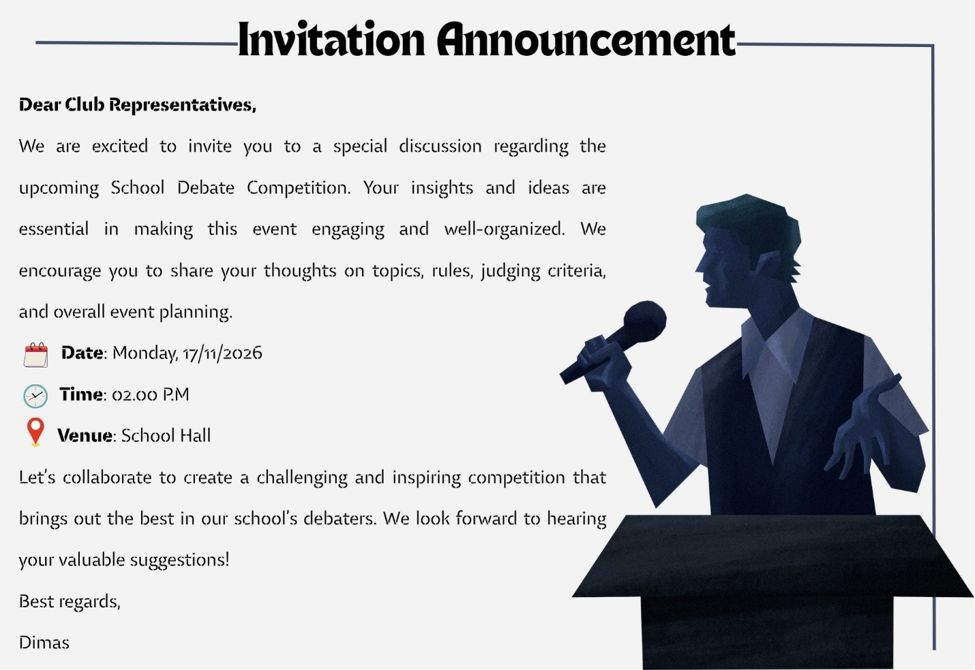
Questions: 1. How can we encourage more students to join and participate confidently? 2. What criteria should the judges consider when evaluating the debaters? 3. What can we do to ensure the debates remain fair, structured, and engaging? 4. How should we promote the competition to attract an audience? 5. Would it be beneficial to invite external judges, such as teachers or debate experts? 6. How can we handle time management and scheduling for different rounds of the competition?
Mission 2. Choose, Challenge, and Convince!
Pick three exciting debate topics that would spark discussion in the competition. For each topic, explain why it’s important, relevant, and worth debating. Choose topics that can have different opinions and strong arguments on both sides to make the debate more engaging! Example: Should Indonesia impose stricter regulations on social media usage for minors? Reason: With the increasing concerns over online safety, cyberbullying, and digital addiction, many argue that Indonesia should enforce stricter regulations on minors' access to social media. Supporters believe that age restrictions, screen time limits, and parental controls would protect young users from harmful content and online threats. However, opponents argue that such regulations may limit freedom of expression and digital literacy, making it essential to find a balanced approach. This debate will encourage students to consider the impact of social media on young people and discuss possible solutions for responsible internet usage.
Mission 3. Evaluating Arguments
Carefully read the dialogue and focus on each speaker’s argument, how they support their point, and how they respond to counterarguments. For each speaker, write a short analysis (3–4 sentences) evaluating whether their argument is strong, weak, or needs improvement. You may also use the guided questions to help structure your response. Rani (Chairperson): "Good afternoon, everyone. Today, we are here to discuss an important issue—should Indonesia impose stricter regulations on social media usage for minors? We will hear different perspectives and aim to find a balanced solution. Let’s begin with Alya." Alya: "Thank you, Rani. I strongly believe that Indonesia should enforce stricter regulations on social media for minors. Studies show that excessive social media use can lead to addiction, anxiety, and even cyberbullying. If we limit screen time and enforce stricter age verification, we can create a safer online space for young users." Budi: "I understand your concerns, Alya, but don’t you think strict regulations could also limit educational opportunities? Many students rely on social media for learning, research, and even networking. Instead of banning or restricting access, wouldn’t it be better to focus on digital literacy programs that teach responsible usage?" Citra: "That’s a valid point, Budi, but not all minors can regulate themselves. Many young users become addicted to scrolling endlessly, affecting their studies and well-being. I believe time limits, parental controls, and school-based monitoring could help prevent excessive usage while still allowing access to educational content." Dika: "I see where you’re coming from, Citra, but who will enforce these regulations? Not all parents or schools have the resources to monitor every student’s social media activity. Also, restricting access might make social media more appealing to minors, leading them to find ways to bypass the rules." Alya: "That’s why we need government intervention. Other countries have successfully implemented regulations, such as requiring platforms to verify the age of users and limiting certain types of content for minors. If we adopt similar policies, we can ensure that social media remains a safe and productive space." Budi: "But don’t you think those rules could interfere with personal freedom? Many minors use social media to express themselves creatively, join discussions, and stay informed about current events. Imposing strict regulations might discourage them from developing independent thinking skills." Citra: "Personal freedom is important, but safety should come first. Just like we have traffic laws to protect drivers and pedestrians, we need social media rules to protect young users. Perhaps a middle ground could be implementing digital education alongside reasonable restrictions." Dika: "I agree that education plays a crucial role, but rather than enforcing strict bans, we should focus on awareness campaigns and encouraging parents to be more involved in their children's social media use. Technology can be beneficial if used correctly, so finding a balance is key." Rani (Chairperson): "This has been a productive discussion, and both sides have raised excellent points. It seems that while regulations can provide safety, education and parental involvement are also crucial in guiding responsible social media use. Let’s take some time to summarize our ideas and propose a potential solution that considers both perspectives." Analysis questions: 1. What is their main point? 2. What reasoning or evidence do they use? 3. How effectively do they respond to counterarguments? Example: Speaker: Alya Arguments/main point: Indonesia should impose stricter social media regulations for minors to prevent addiction and cyberbullying. Analysis: Alya presents a strong argument by citing real concerns about online safety. However, she does not provide specific evidence, such as statistics or case studies, to strengthen her claim. Her argument would be more convincing if she addressed how regulations could be enforced effectively.
Mission 4. Social Media Insights: Read, Analyze, Discuss!
Read a short paragraph about social media usage among minors and examine a chart presenting data on the same topic. Compare the information from both sources, then answer the comprehension and comparison questions. Finally, discuss your findings with a partner or in a small group. A recent study found that 78% of Indonesian minors aged 10–17 use social media daily, with TikTok and Instagram being the most popular platforms. Many parents worry about the risks, including cyberbullying and screen addiction, while others believe social media helps children stay informed and socially connected. The government has debated introducing age restrictions and screen time limits to regulate social media use among minors. Comprehension & Comparison Questions: 1. What key information is presented in the paragraph but not in the chart? 2. What specific details does the chart provide that the paragraph does not mention? 3. Which source makes it easier to understand which social media platforms are most popular? Why? 4. Based on the data, do you think parents’ concerns about social media use among minors are justified? Why or why not? 5. Do you agree with the idea of introducing age restrictions and screen time limits? Support your answer with information from both sources. 6. What additional information would make the paragraph or chart more complete?
Over 60% of teenagers report feeling anxious or pressured because of social media? Studies show that the constant comparison to curated online lives, fear of missing out (FOMO), and the pressure to gain likes and followers contribute to higher stress, low self-esteem, and even depression among teens worldwide. Experts suggest that setting screen time limits, engaging in offline activities, and following positive content can help reduce these negative effects.
Mission 5. Winning Arguments with Respect!
Before we dive deeper into how to argue politely, think critically, and use idioms in debates, read and comprehend the dialogue between Raka and Siti during a school debate club meeting. This will help you understand the key aspects of effective and respectful arguing. A school debate club meeting. Two students, Raka and Siti, are discussing how to argue effectively in a debate while maintaining politeness and respect. Raka: "Siti, I watched yesterday’s debate, and I noticed that even though your points were strong, the judges seemed to favor the other team. Do you think being more aggressive helps in winning a debate?" Siti: "Not necessarily, Raka. A strong argument isn’t about being aggressive—it’s about being persuasive. You can disagree while still being polite and logical. A well-structured argument holds water, but if it's delivered in an aggressive tone, it can lose its impact." Raka: "I see your point, but what if the opponent keeps interrupting or raising their voice? Shouldn’t we match their energy?" Siti: "Not at all. Staying calm and composed gives you an advantage. If you respond with clear reasoning instead of emotion, you show confidence and control. For example, instead of saying, 'You are wrong,' try saying, 'I see your perspective, but I respectfully disagree because…' That way, your argument remains strong without sounding confrontational." Raka: "That makes sense. So, how can I make my arguments more convincing?" Siti: "First, always structure your argument clearly: state your point, support it with evidence, and address counterarguments. Second, use polite urging expressions like, 'It is important to consider that…' or 'I understand your concern, but have you thought about…' Lastly, using idioms can add depth, like saying, 'There are two sides to every coin' to acknowledge different perspectives." Raka: "Got it! So, the key is to stay polite, use strong reasoning, and acknowledge the other side. That’s really helpful!" Siti: "Exactly! If you master these skills, you won’t just argue—you’ll persuade and win with respect."
Urging someone to consider your point of view doesn’t have to be forceful. Using polite language helps maintain respect and makes your argument more persuasive. Common expressions used to urge politely: Acknowledging the other person’s opinion first: "I understand your perspective, but have you considered…?" Gently pushing for action or agreement: "It might be beneficial if we could…" Suggesting a different viewpoint without sounding aggressive: "I see where you're coming from, but another way to look at it is…" Critical thinking is essential when building a strong argument. It means analyzing information carefully, considering different perspectives, and providing logical reasoning. Steps to Think Critically in an Argument: Understand the issue: Gather facts and reliable information before forming an opinion. Identify biases: Recognize personal opinions versus objective facts. Consider different perspectives: A strong argument acknowledges opposing views. Support claims with evidence: Facts, statistics, and examples make your argument convincing. Question assumptions: Ask, "Is this really true?" before accepting or rejecting an idea. Arguing a point of view (POV) means presenting an opinion in a structured and logical way. Steps to Argue a POV Effectively: State Your Claim Clearly: Make sure your opinion is clear and direct ("I believe that school uniforms should be optional."). Provide Supporting Evidence: Use facts, examples, and logic to back up your claim ("Studies show that students feel more confident when they choose their clothing."). Acknowledge the Other Side: Recognize the opposing argument to show fairness ("Some argue that uniforms promote discipline, but they can also limit self-expression."). Reinforce Your Point: Conclude by emphasizing why your POV is stronger ("While discipline is important, students should still have the freedom to express themselves."). Helpful Phrases When Arguing a POV: "From my perspective, I believe that…" / "The evidence suggests that…" / "While some may argue X, I would counter that…" / "Based on these facts, it’s clear that…"
Mission 6. Argue It Well!
In this mission, you will practice critical thinking and develop your ability to argue a point of view (POV) independently. Your task is to construct a well-reasoned argument, anticipate possible counterarguments, and defend your stance effectively in writing. Follow the instructions below carefully to complete the mission. Choose a Debate Topic: - Should schools eliminate homework? - Is social media more harmful than beneficial? - Should junk food be banned in schools? Write a Structured Argument: - State Your Position Clearly - Support It with Evidence or Reasoning - Acknowledge a Counterargument - Refute the Counterargument with Logic Self-Reflection: - What was the strongest part of my argument? - What counterargument was the hardest to refute? - If I had to argue the opposite side, how would I approach it?
| Part | Text |
|---|---|
Mission 7. Understanding Arguments & Idioms!
Carefully read the dialogue and analyze the arguments presented by each speaker. Pay close attention to the idioms used and their meanings within the context. Then, answer the comprehension questions based on your understanding of the dialogue. A group of students—Raka, Siti, Dika, and Maya—are discussing whether Bali should limit tourism to protect its environment and cultural heritage. They express their opinions politely, incorporating idioms to strengthen their arguments. Raka: "I believe Bali should limit the number of tourists to protect its environment. Over the past 50 years, areas like Seminyak and Canggu have transformed from serene rice paddies to bustling resort hubs, leading to environmental degradation and loss of cultural heritage. If we don't act now, we might be killing the goose that lays the golden eggs." Siti: "I understand your concern, Raka, but tourism is the lifeblood of Bali's economy. Restricting it could hurt local businesses and livelihoods. It's important to remember that every cloud has a silver lining; perhaps we can find a way to balance tourism and environmental preservation." Dika: "That's a valid point, Siti. However, the rapid development has led to significant environmental issues, including deforestation and pollution. If we continue to prioritize profit over sustainability, we may be biting the hand that feeds us." Maya: "I see where you're all coming from. Implementing strict tourism limits could be a double-edged sword; while it aims to protect the environment, it might also reduce income for locals. Perhaps a balanced approach, such as promoting sustainable tourism practices and enforcing environmental regulations, would be more effective." Raka: "You have a point, Maya. Maybe we should meet halfway by encouraging eco-friendly tourism and setting guidelines that protect the environment without drastically cutting tourist numbers. After all, it takes a village to preserve the beauty and culture of Bali." Comprehension questions: 1. What is Raka's main concern regarding tourism in Bali? 2. How does Siti view the relationship between tourism and Bali's economy? 3. What environmental issues does Dika highlight as consequences of rapid development? 4. What does Maya suggest as a balanced approach to address the issue? 5. What does the idiom "biting the hand that feeds us" mean in Dika's statement? 6. Which student's argument do you find most convincing, and why? 7. If you were part of this discussion, what solution would you propose to balance tourism and environmental preservation in Bali?
Idioms can make your arguments sound more natural, engaging, and memorable while showcasing your language skills and critical thinking. They help express ideas clearly, making your points more persuasive without sounding too direct or aggressive. Mastering idioms allows you to argue effectively while keeping the conversation dynamic and compelling. How to Use Idioms Effectively in Arguments: Use idioms naturally in context, and make sure the idiom fits the topic and doesn’t feel forced. Use idioms to introduce different perspectives. Example: "Some may argue that tourism helps the economy, but there are two sides to every coin." Use idioms to emphasize the strength of your argument. Example: "This argument holds water because it’s supported by scientific research." Use idioms to politely challenge opposing views. Example: "I see your point, but let me play devil’s advocate—what if this policy harms small businesses?" Don’t overuse idioms. Use them selectively so they enhance, rather than overwhelm, your argument.
Mission 8. Hidden Meanings of Idioms
Carefully read the dialogue and identify the idioms used by each speaker, paying attention to the context in which they appear. Then, analyze their meanings based on how they are used in the conversation. Write down your interpretation of each idiom and explain how it enhances the speaker’s argument. Four university students—Raka, Siti, Dika, and Maya—are discussing whether technology is making people more intelligent or simply more dependent and lazier. Raka: "I believe technology is making people lazier. Before smartphones and the internet, we had to memorize phone numbers, read books to find answers, and do mental calculations. Now, everything is just a click away. We’re letting our brains collect dust!" Siti: "I don’t think that’s fair to say, Raka. Technology doesn’t make us lazy—it makes us more efficient. Why waste time doing calculations in your head when you can use a calculator? Work smarter, not harder." Dika: "I agree with Siti. If anything, technology is expanding our knowledge. We have instant access to unlimited information, and that’s helping people become smarter. The problem isn’t technology itself; it’s how we use it. The ball is in our court." Maya: "That’s true, but don’t you think technology also makes people too dependent? Imagine if GPS stopped working—many people wouldn’t even know how to read a map! We’ve become so used to convenience that we struggle without it. If you don’t use it, you lose it." Raka: "Exactly! People are losing basic skills because they rely too much on technology. Think about how many people can’t cook without YouTube tutorials or how students struggle with math when they can’t use a calculator. Technology is a double-edged sword." Siti: "But isn’t that just a shift in how we learn? In the past, people relied on oral storytelling, then books, and now the internet. Just because we use technology differently doesn’t mean we’re getting dumber. There are two sides to every coin." Dika: "I think the real issue is balance. We should use technology to make life easier, but not let it replace essential thinking skills. It’s about finding the right approach. Everything in moderation." Maya: "That’s a good point. Maybe instead of blaming technology, we should focus on how to use it wisely. After all, knowledge is power, but only if you apply it properly. A tool is only as good as the person using it." Raka: "I suppose that’s true. Technology itself isn’t bad—it depends on how we use it. So, we need to make sure we're in control of technology, not the other way around. Let’s not throw the baby out with the bathwater."
| Idioms | Meaning |
|---|---|
Mission 9. Constructing a Strong Argument
In this activity, you’ll write an argumentative text on a given topic. Follow the steps below to craft a compelling and well-supported argument. Choose One of the Following Topics for Your Argumentative Text: - Should artificial intelligence (AI) be used in decision-making processes in schools? - Is it ethical for companies to collect and sell personal data without consent? - Should the government increase regulations on fast fashion to reduce environmental damage?
| Section | Guiding questions |
|---|---|
Example sentences you might need to use: "It is important to consider that…" "One major reason is that…" "Some people argue that… However,…" "In conclusion, this issue requires serious attention because…" Write Your Argumentative Text! - Use polite and persuasive language. - Support your argument with facts, quotes, or research. - Use idioms or transitions to strengthen your reasoning. - Ensure your writing is well-organized, logical, and supported by evidence.
Gratis — tolong sebarkan
Materi dan latihan di sini bisa dipakai siapa saja tanpa membayar dan tanpa mendaftar. Aplikasi Fitri Learning membawa semuanya ke HP, lengkap dengan nilai dan pembahasan, dan jalan tanpa internet setelah diunduh sekali.
Gratis, tanpa akunUnduh aplikasinya → Ilmu yang bermanfaatBagikan ke WhatsApp