
In this unit, you will learn how to ask insightful questions using question tags to engage in conversations about historical events. You will also practice linking ideas and organizing information from the past to better understand the causes and effects of natural disasters and climate change.
Mission 1. Investigating Climate Change Through Data
Read the data about climate change in the poster provided below carefully and thoroughly. Take your time to understand the key points, paying attention to the details and facts presented. Once you've read the information, answer the following questions based on the data.
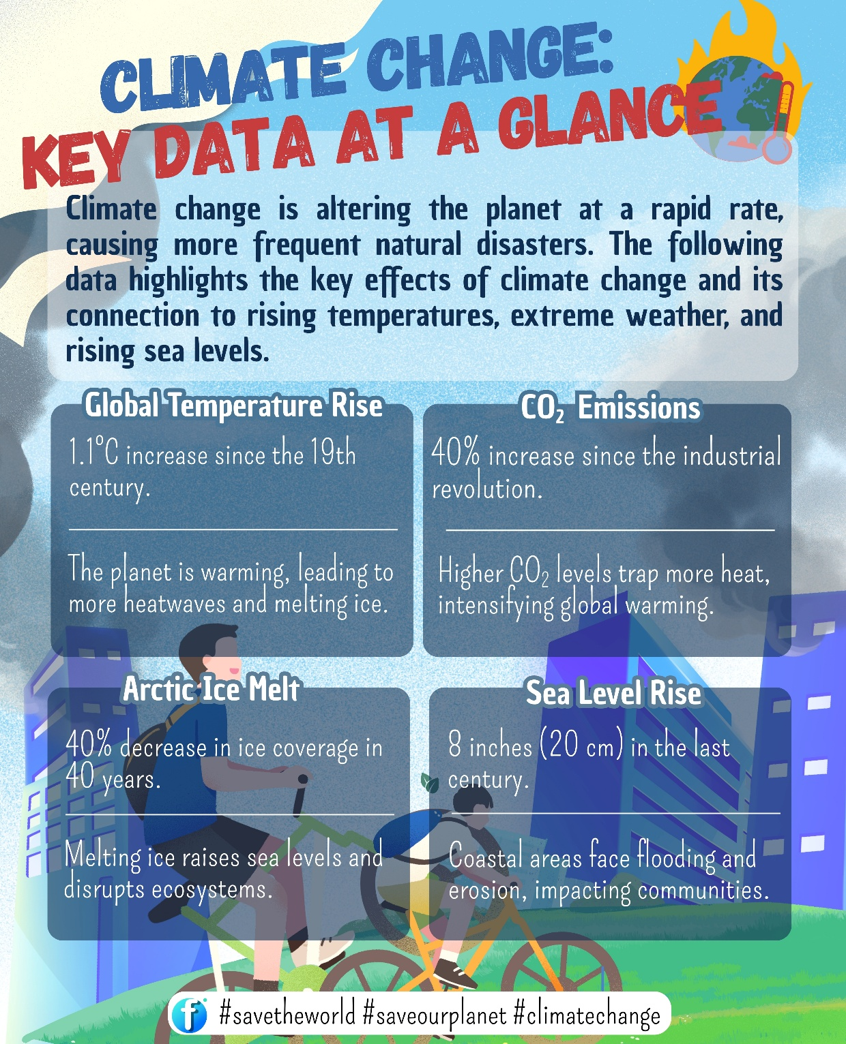
1. What is the global temperature increase since the 19th century, and what are the potential consequences of this rise? 2. How has CO2 emissions changed since the industrial revolution, and how does this affect the global climate? 3. What is the impact of the 40% decrease in Arctic ice coverage on the environment and sea levels? 4. How much has the sea level risen in the last century, and what are the consequences for coastal communities? 5. Based on the data provided, how does climate change contribute to extreme weather events like heatwaves and hurricanes? 6. How do rising temperatures and CO2 emissions influence the melting of ice caps and the rise in sea levels? 7. Why is it important to address climate change based on the data shown in the poster, and what actions can individuals take to mitigate its effects?
Mission 2. Understanding Climate Change Through Discussion
Read the conversation between Aldi and Adit discussing the poster from the previous mission (mission 1). After reading, answer the questions based on your understanding of their discussion. Focus on the key points regarding climate change, rising temperatures, CO2 emissions, and their impact on natural disasters.
Aldi: "Did you see the climate change data in the poster? It's pretty shocking, isn't it?" Adit: "Yes, it really is. The 1.1°C rise in global temperatures over such a short period is pretty significant. We're already seeing the consequences of that, aren't we?" Aldi: "Exactly. And it's not just the temperatures that are rising. CO2 emissions have increased by 40% since the industrial revolution. That really shows how much human activity is influencing the climate." Adit: "It's crazy how much CO2 we've been pumping into the atmosphere. The Arctic has warmed at more than twice the global average rate. It's no wonder that the ice is melting so quickly." Aldi: "Right, and the ice melt is directly contributing to sea level rise. In fact, sea levels have risen by 8 inches in the past century. If this continues, we could see more coastal cities flooded." Adit: "I agree. And the impact is already being felt. The frequency of extreme weather events like heatwaves and hurricanes is growing. I mean, hurricanes are becoming more intense, aren't they?" Aldi: "Yes, they are. With stronger winds and heavier rainfall, these storms are becoming much more destructive. It's harder to ignore the effects of climate change now, isn't it?" Adit: "It definitely is. The data makes it clear. But the good news is that more people are becoming aware of it. The more we understand, the more we can push for action to slow down climate change." Aldi: "Absolutely. Awareness is the first step. If we can all work together, we can make a difference. But it all starts with understanding the facts and taking responsibility for our actions." Adit: "I couldn't agree more. The data is hard to deny, and it's time we took real action before the damage becomes irreversible." Questions: 1. In the conversation, Adit mentions that the global temperature rise of 1.1°C is significant. How does this temperature increase relate to the observable effects of climate change, according to Aldi and Adit? 2. Aldi highlights the 40% increase in CO2 emissions since the industrial revolution. What does this increase imply about human activities, and how does it contribute to the acceleration of global warming, as discussed in the conversation? 3. Adit points out that the Arctic has warmed at more than twice the global average rate. What are the specific consequences of this rapid warming on the environment, and how is this linked to rising sea levels, according to the conversation? 4. According to Aldi and Adit, extreme weather events such as hurricanes and heatwaves are becoming more frequent and intense. How do these events impact communities and ecosystems, based on their discussion? 5. The conversation touches on the idea of awareness and action. Why is it important for more people to understand the data about climate change, and how can increased awareness lead to more effective climate action? 6. In the conversation, Aldi and Adit mention the rise in sea levels due to ice melt. How could rising sea levels affect coastal regions, and what measures might be needed to protect these areas from flooding? 7. Aldi emphasizes that the data on climate change is "hard to deny." How does this statement relate to the urgency of addressing climate change, and what steps do you think are essential to take immediate action?
Mission 3. Fact-Checking the Natural Disaster Timeline
Review the timeline of major natural disasters provided below. Read each statement carefully and determine whether it is true or false based on the data. Mark 'True' or 'False' next to each statement and provide an explanation for why you think it is correct or incorrect.
| Year | Disaster | Location | Magnitude/Impact |
|---|---|---|---|
Now, check the statement list below based on the data provided.
| Statement | True/False |
|---|---|
Mission 4. Connecting the Dots: Dialogue Matching
Read the dialogue carefully. Afterward, match the two related statements based on the information discussed in the conversation. Write the corresponding letter for each pair that you believe belongs together.
Budi: "Have you noticed how many natural disasters have been happening lately? It seems like they're more frequent and severe, doesn't it?" Siti: "Yes, it really is. Last year alone, we saw record-breaking wildfires in Australia and devastating floods in Europe. Clearly, climate change plays a major role in these events." Budi: "Exactly. Rising global temperatures are causing more extreme weather patterns. Hurricanes are also getting stronger. Do you remember the damage caused by Hurricane Maria in Puerto Rico?" Siti: "I do. That storm caused widespread destruction and took months to recover. The infrastructure still hasn't fully recovered." Budi: "It's heartbreaking. And the rising sea levels due to melting ice caps are only making flooding in coastal areas worse." Siti: "Right, and it's not just coastal areas that are at risk. Inland areas are facing extreme heatwaves and droughts, which are damaging crops and causing water shortages." Budi: "That's true. For instance, the drought in California last year led to serious water scarcity, forcing many farmers to abandon their crops." Siti: "That's a huge impact. And let's not forget about people who are displaced by these disasters. Climate change is creating more climate refugees, and that number is only going to rise." Budi: "I agree. But there are things we can do, like reducing emissions and switching to renewable energy sources. But it's going to take all of us working together." Siti: "Exactly. We need to act quickly and responsibly to avoid further damage or we'll keep seeing more disasters."
Match the Statements
| Statement (What Happened) | Reason (What Caused It) |
|---|---|
A question tag is a short question added to the end of a statement, often used to confirm information or seek agreement. It turns a statement into a question, and it's commonly used in conversation to make the tone more engaging. Structure of question tags: Positive Statement → Negative Question Tag: If the sentence is positive, the question tag is negative. Example: You're coming to the party, aren't you? Negative Statement → Positive Question Tag: If the sentence is negative, the question tag is positive. Example: She isn't going to the meeting, is she? Forming question tags: With Auxiliary Verbs (Be, Do, Have, Will, etc.) With Modals (Can, Could, Should, etc.) With Main Verbs (Without Auxiliary Verbs): If there is no auxiliary verb, "do" is used as the auxiliary for forming a question tag. The use of question tags: To Confirm Information: "You're coming to the event tomorrow, aren't you?" (Used to check if the person is indeed coming.) To Seek Agreement: "It's a beautiful day, isn't it?" (Used to encourage the other person to agree with the statement.) To Show Interest or Surprise: "They've never been to the new museum, have they?" (Used when expressing surprise or seeking more information.) Examples: You like pizza, don't you? (You are asking for confirmation.) They haven't seen that movie, have they? (You are asking for confirmation with a negative statement.) She's very good at cooking, isn't she? (You are seeking agreement with a positive statement.) Notes: The subject in the question tag is always a pronoun (you, he, she, it, they, etc.). The auxiliary verb (e.g., "are," "is," "has") in the question tag matches the auxiliary verb or main verb used in the statement. Intonation: The intonation of the question tag changes its meaning. If spoken with a rising intonation, it's often a genuine question (asking for confirmation). If spoken with a falling intonation, it's often a statement seeking agreement or showing interest.
Mission 5. Identifying and Discussing Question Tags
Read the conversation below carefully. Identify all the question tags in the conversation and write them in the table provided. After completing the activity, discuss with a partner why each question tag fits its statement and what role it plays in the conversation.
Aldi: "The weather has been so unpredictable lately, hasn't it?" Siti: "Yes, it's been crazy! One minute it's sunny, the next minute it's raining. Climate change is really affecting weather patterns, isn't it?" Aldi: "Absolutely. I've noticed that it's been getting hotter every year, don't you think?" Siti: "I do! And the storms we're seeing now are much more intense, aren't they? It's like they're happening more frequently." Aldi: "I read a report that said hurricanes are becoming stronger and more destructive because of rising ocean temperatures, didn't I?" Siti: "Yes, you did. I've read the same thing. The ice caps are melting, and sea levels are rising, aren't they?" Aldi: "Exactly. Coastal cities are at such high risk, aren't they? It's really concerning." Siti: "I know, right? And the pollution from factories and cars isn't helping, is it?" Aldi: "No, not at all. We really need to reduce our carbon footprint, don't we?" Siti: "Yes, but it's going to take a lot of effort from all of us, isn't it?" Aldi: "Definitely. But I think we can make a big difference if everyone works together, can't we?" In the table below, write the question tag you find in the conversation. Pay attention to whether the statement is positive or negative, and match it with the correct question tag.
| Question Tag | Statement (Find in the Conversation) |
|---|---|
Mission 6. Fill the Gap with Question Tags
Dive into the conversation and read it carefully. Complete the dialogue by filling in the blanks with the correct question tags.
Andi: "The earthquakes in Indonesia have been quite frequent lately, ______?" Rina: "Yes, it's worrying, ______? Just last month, we had two major quakes in just one week!" Andi: "It seems like the frequency of these earthquakes is increasing, ______? I read that seismic activity is on the rise due to shifting tectonic plates." Rina: "I agree. And the flooding we've seen in Jakarta recently, ______? It's getting worse every year." Andi: "Exactly. The rising sea levels are contributing to the flooding, ______? That's another major issue we're facing." Rina: "Yes, the coastal areas are becoming more vulnerable to these disasters, ______? I heard the government is working on a solution." Andi: "That's true. But we still have a lot of work to do, ______? We need to improve infrastructure and flood control systems." Rina: "Absolutely. And the wildfires in Kalimantan, ______? They've been spreading faster due to prolonged droughts." Andi: "It's alarming, ______? The damage to the environment and air quality is huge." Rina: "Definitely. But there is hope, ______? If we take action, we can reduce the severity of these disasters." Andi: "Yes, I believe so. But we need global cooperation and faster response, ______?" Rina: "Absolutely, the sooner we act, the better, ______? We can still make a difference."
When telling a story in the past, it's essential to use connectors and transition words that help sequence the events in an organized and clear manner. These connectors guide the listener or reader through the events step by step, and they help to establish the timeline of the story.
Common Connectors
| Function | Common Connectors | Example |
|---|---|---|
Mission 7. Building Flow: Using Connectors in Storytelling
Read the paragraph below and fill in the blanks with the appropriate connectors from the list provided. Once you've completed the activity, discuss how the connectors improve the flow of the story and help in understanding the sequence of events.
A Walk Through the Storm
It was a bright and sunny morning when I decided to go on a hike. ______ (1), I packed my bag with snacks, a water bottle, and my camera. ______ (2), I put on my boots and made sure I had my map and compass, just in case. ______ (3), I started walking along the trail that led through the forest. The air was fresh, and I felt excited to explore the woods. However, as I walked deeper into the forest, I noticed dark clouds gathering overhead. ______ (4), it started to rain heavily, and I quickly realized I needed to find shelter. I ran toward a small cabin I had seen earlier on the trail. ______ (5), I arrived just in time and found that the cabin was open and empty. I took refuge inside and lit a small fire to warm up. ______ (6), I noticed that the rain had stopped, and the sun was starting to peek through the clouds. I decided to leave the cabin and continue my hike. ______ (7), I retraced my steps back to the trail, but I couldn't shake the feeling that something had changed in the forest. ______ (8), I made it back to the starting point just before dusk. ______ (9), I realized that despite the storm, I had had a great adventure.
Mission 8. Connecting Terms to Real-World Contexts
Match the terms on the left with their correct definitions on the right. Then, write a sentence for each term using the context of climate change or natural disasters. Once you've completed the activity, share your sentences with a partner or the class to see how well the vocabulary fits into real-world contexts. Word box: Global Warming / Drought / Renewable Energy / Carbon Footprint / Deforestation / Mitigation / Flooding / Natural Disaster / Sustainability / Greenhouse Gases
| Definition | Term |
|---|---|
Mission 9. Sequencing Events
Read the set of sentences below and use the provided connectors to arrange them in chronological order. After sequencing the sentences, rewrite them into a coherent paragraph. Sentences to arrange:
The coastal city faced severe flooding. The government issued a flood warning. The residents evacuated to higher ground. They received warnings about rising water levels. The heavy rainfall continued for hours. Emergency teams provided aid to those in need. The floodwaters receded, and the damage was assessed. Many houses were damaged, and crops were destroyed. Write the sentences into a cohesive paragraph about a natural disaster (flooding) caused by heavy rainfall. Make sure the sequence is clear and the cause-and-effect relationships are indicated through the correct use of connectors. Completed paragraph: "First of all, the government issued a flood warning as soon as they received reports of rising water levels. ……………………………………………………………………………………………………………………………………………………………………………………………………………………………………………………………………….……………………………………………………………………………………………………………………………………….."
The 2004 Indian Ocean earthquake and tsunami was one of the most devastating natural disasters in recorded history. It resulted from a massive undersea earthquake with a magnitude of approximately 9.1–9.3, making it one of the strongest earthquakes ever recorded. The earthquake caused the seafloor to uplift by several meters, displacing a vast amount of water and generating tsunami waves that radiated across the Indian Ocean. These waves struck the coasts of 14 countries, including Indonesia, Sri Lanka, India, and Thailand, leading to widespread devastation. The disaster claimed the lives of over 230,000 people and left millions homeless. The event highlighted the need for improved early warning systems and international cooperation in disaster response.
Gratis — tolong sebarkan
Materi dan latihan di sini bisa dipakai siapa saja tanpa membayar dan tanpa mendaftar. Aplikasi Fitri Learning membawa semuanya ke HP, lengkap dengan nilai dan pembahasan, dan jalan tanpa internet setelah diunduh sekali.
Gratis, tanpa akunUnduh aplikasinya → Ilmu yang bermanfaatBagikan ke WhatsApp